
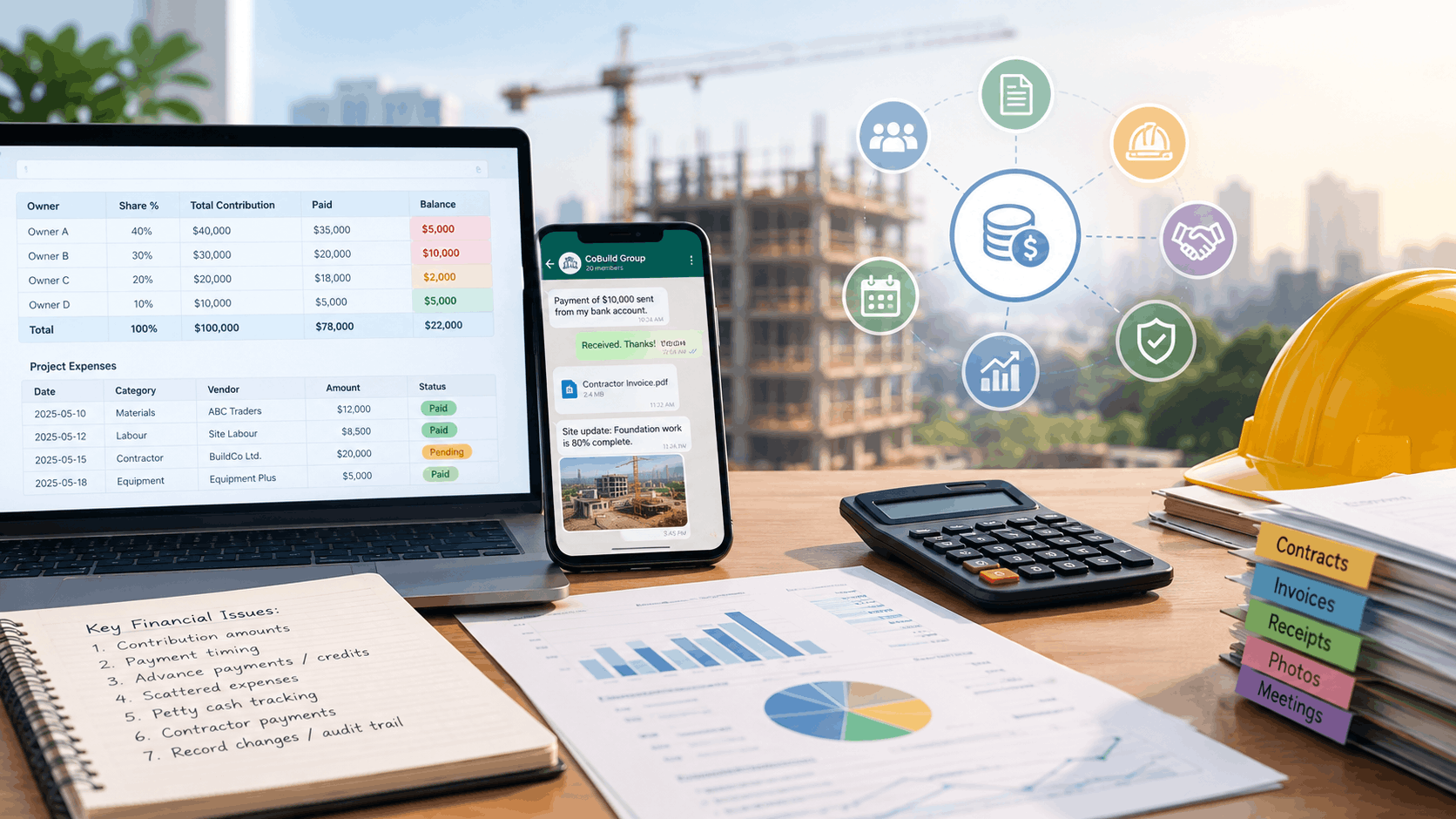
When several people jointly own a property and finance its construction, managing the money is fundamentally different from managing the finances of a single-owner project.
There may be dozens of contributors, hundreds of transactions, multiple contractors, recurring funding requests, and different ownership percentages.
At the beginning, a simple spreadsheet may be enough.
But as the project grows, financial management can become increasingly difficult.
The problem isn't necessarily that anyone is doing something wrong.
The problem is that shared construction finances are inherently complex.
Here are seven of the most common financial problems co-owned construction projects face.
1. Unclear Contribution Amounts
One of the first challenges is determining exactly how much each co-owner should contribute.
If everyone owns an equal share, the calculation is relatively simple.
But many projects don't have equal ownership.
For example:
| Co-owner | Ownership |
|---|---|
| Owner A | 40% |
| Owner B | 30% |
| Owner C | 20% |
| Owner D | 10% |
If the project needs to collect $100,000, the expected contributions would be:
- Owner A — $40,000
- Owner B — $30,000
- Owner C — $20,000
- Owner D — $10,000
However, real projects can be more complicated.
Some projects use ownership multipliers to account for differences such as unit size, floor level, or other project-specific factors.
Previous payments can also affect the calculation.
This means a simple question like:
"How much do I owe for this month's construction funding?"
may require several calculations.
When these calculations are performed manually, errors can easily occur.
The better approach
Each co-owner's obligation should be calculated from a clearly defined ownership structure.
The system should be able to show:
Ownership → Calculation → Amount Due → Amount Paid → Outstanding
That makes the contribution transparent rather than subjective.
2. Different Members Pay at Different Times
Construction funding rarely arrives from everyone on the same day.
One co-owner may pay immediately.
Another may pay a week later.
Someone else may make only a partial payment.
Another person may pay in advance.
This creates a reconciliation problem.
Suppose a project requests $50,000 from a group of co-owners.
The finance manager needs to know:
- Who has paid?
- How much has each person paid?
- Who has partially paid?
- Who hasn't paid?
- How much remains outstanding?
If this information is maintained manually, the spreadsheet needs to be updated every time a payment arrives.
And when payments come through different bank accounts or payment methods, reconciliation becomes even more complicated.
The better approach
Each payment should be recorded against the relevant co-owner and contribution schedule.
That creates a real-time picture of collection progress.
Instead of asking someone for an update, the group can see the status directly.
3. Advance Payments and Credit Balances Get Lost
This is a particularly common problem in co-owned projects.
A co-owner may decide to pay more than their current obligation.
For example:
Current obligation: $10,000
Payment made: $15,000
Credit: $5,000
What happens to that extra $5,000?
In a simple spreadsheet, someone may write a note saying that the member has a $5,000 credit.
But several months later, that information may be overlooked.
When the next contribution is requested, the member may be asked to pay the full amount again.
This creates unnecessary confusion and can quickly lead to disputes.
The better approach
Advance payments should automatically create a credit balance for the member.
That credit can then be carried forward and offset against future obligations.
The financial record should clearly show:
Amount Due → Amount Paid → Credit → Next Obligation
This eliminates the need to maintain separate personal notes.
4. Expenses Are Scattered Across Different Places
Money doesn't only come into a construction project.
It also goes out in many different ways.
A typical project may have expenses for:
- Contractors
- Building materials
- Labour
- Equipment
- Transportation
- Permits
- Professional services
- Utilities
- Site expenses
- Petty cash
If these expenses are recorded in different spreadsheets, receipts, notebooks, emails or messages, it becomes difficult to understand the project's actual financial position.
Someone might ask:
"How much have we spent on the project so far?"
The answer should be straightforward.
But if someone needs to collect information from several sources before answering, the financial system is already fragmented.
The better approach
Every project expense should have a structured record containing relevant information such as:
- Amount
- Date
- Expense category
- Vendor
- Payment status
- Bank account
- Supporting documentation
This creates a centralized financial picture.
5. Petty Cash Is Easy to Lose Track Of
Construction sites often require small, frequent payments.
Workers need supplies.
Transportation needs to be paid.
Small materials need to be purchased.
Someone may need cash for an urgent site expense.
This is where petty cash becomes useful.
But petty cash can also become one of the least transparent parts of a construction project's finances.
Suppose $5,000 is transferred from the project bank account into petty cash.
Over the next few weeks, multiple small expenses are paid.
Without proper tracking, it becomes difficult to answer:
- How much cash remains?
- What was the cash spent on?
- Who made each payment?
- Which expenses have receipts?
- Was unused cash returned?
The better approach
Petty cash should be treated as another financial account.
The project should track:
Bank → Petty Cash Transfer → Individual Expenses → Remaining Cash → Return to Bank
This creates a complete trail for physical cash.
6. Contractor Payments Don't Always Match Actual Progress
Construction projects can involve significant payments to contractors.
The financial risk increases when payments are made before the corresponding work is verified.
Imagine a contractor has a $100,000 contract.
The work is divided into several milestones.
If payments are released simply because the contractor requests them, the project may end up paying for work that is incomplete.
This becomes especially problematic when several co-owners are funding the project.
The better approach
Contractor payments should be connected to measurable work.
A simple payment gate can be:
Complete → Approve → Release
First, the relevant milestone is completed.
Then the work is verified and approved.
Only after approval is the payment released.
This creates a direct relationship between construction progress and financial expenditure.
It also gives the group better control over contractor payments.
7. Nobody Knows Whether the Numbers Can Be Trusted
This is perhaps the most important financial problem.
Imagine that a project expense was recorded as $8,000.
Later, the spreadsheet shows $10,000.
What happened?
Was there an additional payment?
Was the original entry incorrect?
Did someone edit the spreadsheet?
Was supporting documentation added?
Without a proper change history, it may be impossible to know.
This isn't only a security problem.
It can also happen because of completely legitimate human mistakes.
Someone may accidentally edit the wrong cell.
Someone may overwrite an amount.
Someone may delete an old entry.
Without an audit trail, the project loses the ability to reconstruct what happened.
The better approach
Financial records should maintain a history of important changes.
For example:
Original amount: $8,000
Updated amount: $10,000
Changed by: Authorized user
Changed at: Timestamp
Previous state: Preserved
This makes financial information much more trustworthy.
Why These Problems Are Connected
These seven problems may look separate, but they are closely related.
Consider a typical funding cycle.
The project needs money.
First, the group needs to determine how much each co-owner owes.
Then the contribution request needs to be communicated.
Members make payments.
Payments need to be matched to their obligations.
Advance payments need to become credits.
The collected money is then used to pay contractors and suppliers.
Those expenses need to be connected to the construction work.
Finally, everyone needs to know where the money went.
So the actual flow looks something like this:
Ownership → Contribution → Payment → Balance → Expense → Construction Progress → Reporting
If each part is managed separately, errors and confusion can appear between the gaps.
A stronger financial system connects these steps.
What Good Co-Build Financial Management Looks Like
A well-managed co-owned construction project should make it easy to answer basic financial questions.
For the whole project
- How much has been collected?
- How much has been spent?
- How much money is currently available?
- What are the upcoming funding requirements?
- Which expenses are pending?
- Are costs within budget?
For each co-owner
- What is my ownership share?
- How much have I been asked to contribute?
- How much have I paid?
- How much do I still owe?
- Do I have a credit balance?
- How were my contributions calculated?
For contractors
- What work was contracted?
- What is the contract value?
- Which milestones are complete?
- Which payments have been approved?
- How much has been paid?
- What remains payable?
For accountability
- Who recorded the transaction?
- When was it recorded?
- Has it been changed?
- What was the previous value?
- What documentation supports it?
When these questions can be answered quickly, financial management becomes much easier.
The Role of a Centralized Financial System
The objective isn't simply to replace a spreadsheet with another application.
The real objective is to create a single financial source of truth for the project.
A centralized system can connect:
- Members
- Ownership
- Properties
- Contributions
- Deposit schedules
- Payments
- Credit balances
- Expenses
- Vendors
- Contractors
- Bank accounts
- Petty cash
- Budgets
- Construction milestones
- Audit history
This creates something that a collection of spreadsheets and chat messages cannot easily provide:
context.
A payment isn't just a number.
It can be connected to a member, a contribution schedule, a project phase and the relevant financial records.
Likewise, an expense isn't just an amount.
It can be connected to a vendor, a construction milestone, an approval and supporting documentation.
That connected context is what makes financial information much more useful.
Financial Transparency Builds Trust
Money is often the most sensitive part of a co-owned construction project.
People may disagree about design choices.
They may have different opinions about contractors.
But financial uncertainty can create much deeper problems.
When everyone can see how contributions are calculated, where money is spent, what remains outstanding, and how financial records changed over time, there is less room for misunderstanding.
Transparency doesn't eliminate every disagreement.
But it makes disagreements easier to resolve using facts.
Conclusion
Co-owned construction projects face unique financial challenges because multiple people are contributing money to the same property while construction expenses continue to change over time.
The seven problems are closely connected:
- Unclear contribution amounts
- Different payment timing
- Lost advance-payment credits
- Scattered expenses
- Uncontrolled petty cash
- Contractor payments disconnected from progress
- Financial records that are difficult to trust
None of these problems necessarily means that someone is mismanaging the project.
Most are simply consequences of relying on manual processes as the project becomes more complex.
The solution is to create a financial system where ownership, contributions, payments, expenses, construction progress and accountability are connected.
When the numbers are clear, accessible and traceable, everyone involved has a better understanding of the project's financial position.
And in a co-owned construction project, that clarity is one of the foundations of trust.
Share this article
Found this helpful? Share it with your team or co-owners.