
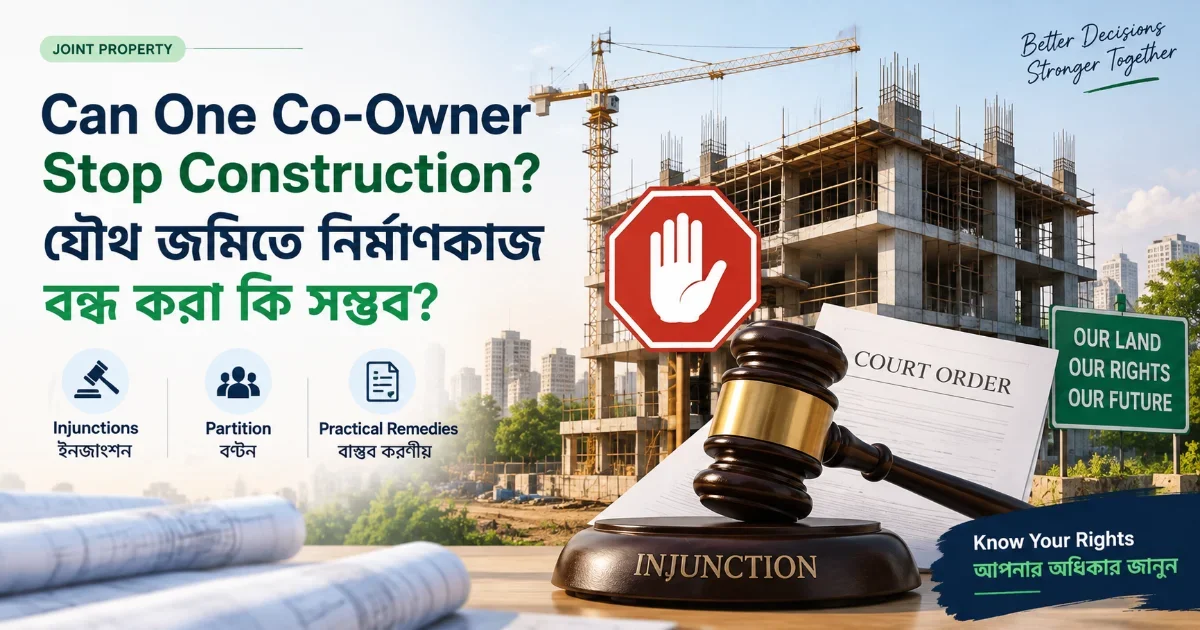
When several people jointly own land in Bangladesh, construction can become one of the most sensitive issues between them.
One co-owner may want to start building immediately.
Another may believe that construction will affect their share.
Someone may claim that a particular portion belongs to them, even though the land has never been formally partitioned.
Others may worry that once a permanent structure is completed, the future division of the property will become much more complicated.
These situations are common in inherited property, family-owned land, joint investments and group construction projects.
A natural question then arises:
Can one co-owner stop another co-owner from constructing on jointly owned property?
The answer is not always simple.
Whether a court in Bangladesh grants an injunction can depend on the nature of the ownership, possession, the proposed construction, the rights being affected and the particular facts of the dispute.
This article provides a practical overview of the issue from a Bangladesh perspective. It is intended for educational purposes and should not be treated as legal advice for a specific dispute.
Joint ownership does not always mean a specific part belongs to a specific person
One of the most important concepts to understand is the difference between:
- owning a share in a property, and
- owning a physically identified part of that property.
Suppose three people jointly own a piece of land.
Each may have a one-third ownership interest.
But if the property has not been legally partitioned or otherwise validly allocated, that does not automatically mean each person owns a clearly identified physical one-third portion.
Bangladeshi courts have repeatedly dealt with the principle that, in an undivided joint property, a co-sharer's interest extends throughout the joint property until lawful partition determines the separate shares and boundaries. Supreme Court of Bangladesh
This is particularly important when construction begins.
A co-owner may say:
"I am building only on my share."
But an important legal question may still remain:
Has that specific physical portion actually been allocated to that co-owner?
If not, construction may create complications during a future partition.
What is an injunction?
An injunction is a court order that can restrain a person from doing something or, in some circumstances, require a person to take certain action.
Under Bangladesh's Specific Relief Act, 1877, preventive relief may be granted through temporary or perpetual injunctions. Temporary injunctions are regulated by the Code of Civil Procedure, while a perpetual injunction may be granted by a final decree on the merits of the case. BD Laws
In construction disputes, an aggrieved co-owner may seek different forms of relief depending on the circumstances.
For example:
- stopping ongoing construction temporarily;
- maintaining the existing status quo;
- restraining interference with a person's legal rights;
- seeking partition of the joint property;
- seeking a declaration of rights where title is disputed;
- in appropriate circumstances, seeking mandatory relief requiring certain acts to be performed.
Bangladesh's Specific Relief Act also recognises mandatory injunctions where the court considers it necessary to compel certain acts in order to prevent the breach of an obligation. BD Laws
However, an injunction is not automatic simply because the parties are co-owners.
A co-owner cannot automatically obtain an injunction against another co-owner
This is one of the most important practical points.
Joint ownership by itself does not necessarily mean that one co-owner can completely prevent another co-owner from using or enjoying the joint property.
Bangladeshi court decisions have recognised that every co-sharer has rights in an undivided joint property and that disputes between co-sharers often need to be resolved through partition or another appropriate legal remedy rather than through a simple injunction alone. Supreme Court of Bangladesh
For this reason, a court may examine questions such as:
- Does the applicant have a prima facie legal right?
- Is there a genuine threat to that right?
- What is the balance of convenience?
- Is there a risk of irreparable loss or injury?
- Is the disputed portion clearly identified?
- Has the property already been partitioned?
- Is one co-owner claiming exclusive possession?
- Will the construction permanently affect the rights of other co-owners?
These factors can be more important than simply asking:
"Who owns the larger share?"
When construction may create a stronger case for court intervention
Not every construction dispute is the same.
The circumstances can significantly affect the available remedies.
1. Construction that interferes with common use
A dispute may become more serious when construction blocks or interferes with an area used jointly by the co-owners.
For example:
- a common access road;
- an entrance or exit;
- a passage;
- a staircase;
- a shared courtyard;
- an area reserved for common facilities.
Construction affecting common use can directly interfere with the rights of other co-owners.
In such a situation, the facts surrounding the designation and use of the area become particularly important.
For group construction projects, this is one reason why common areas should be clearly defined before construction begins.
Do not rely solely on verbal understanding.
Record the agreed layout.
Identify common areas.
Keep approved drawings.
Document the decisions.
2. Construction that makes future partition difficult
Permanent construction can change the practical realities of a property.
Imagine a jointly owned plot where one co-owner constructs a large building over a strategically important portion of the land.
Years later, the property is brought before a court for partition.
The physical structure may make a simple division far more complicated.
Bangladeshi courts have recognised that, until final allotment of shares, a co-sharer is generally considered to have an interest throughout the joint property. Courts may therefore be cautious about granting relief that effectively determines exclusive possession before the underlying rights and shares are finally resolved. Supreme Court of Bangladesh
This does not mean that construction is always prohibited.
It means that construction on undivided property can carry legal risk.
3. Construction accompanied by exclusion or denial of another co-owner's rights
The situation becomes more serious when construction is connected with conduct such as:
- physically preventing another co-owner from accessing the property;
- denying that another person has any ownership interest;
- attempting to permanently exclude another co-owner;
- treating joint property as exclusively owned without a proper legal basis.
A dispute involving ownership, possession and exclusion may require more than a simple request to stop construction.
Depending on the facts, questions of title, possession, declaration and partition may need to be addressed.
Bangladeshi courts have also recognised that where co-sharer disputes concern possession, the appropriate remedy depends heavily on the facts and whether exclusive possession of a defined portion can actually be established. Supreme Court of Bangladesh
Temporary injunction: stopping work before the case is decided
Construction disputes often create urgency.
Concrete is poured.
Columns are erected.
Floors are completed.
Once major structural work is finished, restoring the previous position may become difficult and expensive.
For this reason, a party may seek a temporary injunction while the main case is still pending.
Order XXXIX of the Code of Civil Procedure provides for temporary injunctions in situations including where property in dispute is in danger of being wasted, damaged or alienated, as well as in suits seeking to restrain breach or injury. BD Laws
But obtaining a temporary injunction is not automatic.
The court will generally consider whether there is a sufficient basis for interim protection.
In co-owner disputes, the court may also be careful not to effectively decide the final ownership or possession issue through an interim order.
In some cases, maintaining status quo may be considered more appropriate than giving one co-owner unrestricted control over the disputed property.
Recent Bangladesh Supreme Court decisions have reflected this cautious approach, including situations where maintaining the existing position was considered preferable while a partition dispute remained unresolved. Supreme Court of Bangladesh
What does a status quo order mean?
A status quo order generally aims to preserve the existing situation while the dispute is being resolved.
Depending on the wording of the court's order, this may mean that parties cannot:
- continue certain construction activities;
- change possession;
- transfer the disputed property;
- alter the physical condition of the property.
The exact effect depends on the actual court order.
This is important because people often casually use the phrase:
"There is a status quo."
But legally, the precise wording and scope of the order matter.
A party should always obtain proper legal advice about what a particular order permits or prohibits.
Partition is often the long-term solution
When the real problem is that co-owners can no longer agree on how to use jointly owned land, the fundamental solution may be partition.
Partition determines how the joint ownership should be separated according to the legal rights of the parties.
Bangladeshi courts have repeatedly described partition as an important remedy for resolving disputes among co-sharers over an undivided property. Supreme Court of Bangladesh
A court may consider matters such as:
- the respective shares of the co-sharers;
- existing possession;
- previous lawful arrangements;
- the physical condition of the property;
- whether the property can practically be divided.
Importantly, construction carried out before or during a partition dispute may create additional complications.
A recent Supreme Court decision noted the practical risk that a co-sharer may construct on property at their own risk while partition rights remain unresolved. If the constructed area ultimately falls within another co-sharer's allotted share, the consequences can become serious. Supreme Court of Bangladesh
This is a powerful warning for anyone planning a major construction project on undivided land.
"I paid for the construction" does not automatically resolve ownership rights
Another common misunderstanding arises when one co-owner pays more money for construction.
Suppose:
- four people jointly own land;
- one person spends a large amount constructing a building;
- the property has not been properly allocated between the co-owners.
The person who paid for the construction may naturally believe:
"I paid for this entire building, so this part is exclusively mine."
But property rights, land ownership, contractual arrangements and construction expenditure are not always the same legal question.
The legal outcome can depend on:
- the title documents;
- the ownership arrangement;
- any development or joint venture agreement;
- any written allocation agreement;
- the actual possession;
- the nature of the expenditure;
- whether the co-owners consented;
- the outcome of any partition proceeding.
This is why a group should never assume that financial contribution alone will solve future ownership disputes.
Document the arrangement before construction begins.
The biggest mistake: starting construction based only on verbal agreement
Many disputes begin with a simple conversation.
Someone says:
"You can build on this side."
Another person agrees.
Years later, people remember the conversation differently.
One co-owner may say the arrangement was temporary.
Another may say it was permanent.
A new heir may enter the ownership structure.
A co-owner may sell their interest.
The original understanding may never have been properly documented.
For a construction project involving multiple owners, important agreements should be formally documented with appropriate professional advice.
Depending on the project, this may include:
- ownership records;
- share percentages;
- property allocation arrangements;
- development agreements;
- construction agreements;
- approved architectural plans;
- common-area rules;
- cost-sharing arrangements;
- decision-making procedures;
- dispute-resolution provisions.
The more money and construction involved, the more dangerous it becomes to rely solely on memory and verbal assurances.
A different situation: a planned group construction project
Not all co-ownership disputes involve family land or inherited property.
In Bangladesh, many groups jointly:
- purchase land;
- register ownership;
- appoint architects and engineers;
- obtain approvals;
- construct an apartment building;
- divide apartments or units among the co-owners.
These projects have a different type of risk.
The dispute may not be:
"Who owns this land?"
Instead, it may be:
"Who authorised this design change?"
"Why was the contractor changed?"
"Why was extra money collected?"
"Who approved this additional floor?"
"Why was common space allocated differently?"
"Who is responsible for a construction delay?"
In these situations, preventing legal disputes requires more than understanding injunction law.
The project needs a governance system.
Before construction starts, co-owners should agree on these issues
A well-organised co-owned construction project should address the following before major work begins.
Ownership and allocation
Clearly document:
- who owns the land;
- each person's ownership percentage;
- the intended allocation of apartments, floors or units;
- common areas;
- parking arrangements;
- roof rights, where relevant;
- future transfer rights.
Authority to make decisions
Decide:
- who can approve construction work;
- which decisions require all co-owners;
- which decisions can be made by a committee;
- how voting works;
- how decisions are formally recorded.
Construction changes
Create a process for:
- design changes;
- scope increases;
- contractor changes;
- budget increases;
- material substitutions.
No major change should depend only on a phone call or an informal group message.
Financial responsibilities
Record:
- how much each co-owner must contribute;
- how contributions are calculated;
- payment deadlines;
- treatment of late payments;
- advance payments and credit balances;
- approval rules for major expenses.
Construction verification
Before contractor payments are released, determine:
- who verifies completed work;
- how progress is measured;
- who approves milestone completion;
- what documentation is required.
These controls do not eliminate legal disputes.
But they can prevent many disputes from starting.
A practical example
Imagine a group of ten people jointly purchases land in Dhaka to build a residential building.
The group agrees verbally that each person will receive one apartment.
Construction begins.
Two years later:
- the cost has increased significantly;
- the original design has changed;
- one member has paid more than others;
- parking allocation is unclear;
- some members claim they never approved certain decisions.
At this point, a legal dispute may involve far more than the construction itself.
Questions may arise about:
- ownership;
- contractual obligations;
- authority;
- financial contributions;
- approved decisions;
- common areas;
- allocation of units.
If the group had documented these matters from the beginning, many of the factual disputes could have been easier to resolve.
This is where proper project management becomes part of risk management.
Injunction should not be the group's first management strategy
When a dispute arises, people sometimes immediately think:
"I will get a court order and stop everything."
Sometimes urgent legal intervention may indeed be necessary.
But litigation can be expensive, time-consuming and disruptive.
More importantly, an injunction may only address the immediate activity.
It may not solve the underlying problem.
For example, stopping construction does not automatically answer:
- who owns which portion;
- who should bear additional costs;
- how the building will ultimately be divided;
- whether a contractor has breached its obligations;
- how previous payments should be accounted for.
The underlying dispute may still require:
- negotiation;
- mediation;
- contractual enforcement;
- declaration of rights;
- partition;
- or another appropriate legal proceeding.
The correct remedy depends on the facts.
What should a co-owner do when unauthorised construction begins?
If you believe another co-owner is carrying out construction that may seriously affect your rights, acting early is generally more practical than waiting until the building is complete.
A sensible first response may include the following steps.
1. Gather the documents
Collect relevant records, including:
- title documents;
- mutation and land records where relevant;
- previous agreements;
- partition documents, if any;
- approved building plans;
- development agreements;
- photographs and videos;
- correspondence between co-owners;
- meeting decisions.
2. Identify the actual legal problem
Be specific.
Is the problem:
- disputed ownership?
- disputed possession?
- construction on a common area?
- construction outside an agreed plan?
- construction affecting your access?
- construction that may prejudice future partition?
- breach of an agreement?
The correct remedy may depend on the answer.
3. Preserve evidence
Construction changes quickly.
Keep dated photographs and records.
Preserve relevant messages and documents.
Do not alter evidence.
4. Seek professional legal advice promptly
Property disputes are highly fact-specific.
A lawyer can examine the title documents, possession, agreements and construction circumstances before advising on possible remedies.
5. Do not take physical action yourself
Avoid:
- forcibly stopping workers;
- damaging construction;
- removing materials;
- physically excluding other parties.
Self-help can escalate a dispute and create additional legal problems.
Use lawful procedures.
The lesson for co-owned construction groups
The best time to think about injunctions is before anyone needs one.
A group that is about to construct a building should ask:
What happens if we disagree halfway through the project?
If the answer is:
"We will figure it out later."
The group is taking unnecessary risk.
Before construction begins, establish:
- clear ownership records;
- unit or property allocation principles;
- written agreements;
- approved plans;
- governance rules;
- financial controls;
- formal decision records;
- contractor contracts;
- change-control procedures;
- access to project documents for relevant co-owners.
A transparent project management system can also reduce factual disputes by maintaining a reliable history of:
- who approved a decision;
- when a decision was made;
- what amount was approved;
- how much each co-owner contributed;
- which contractor was engaged;
- what work was completed;
- what changes were made.
When a dispute occurs, reliable records can become extremely important.
Final thoughts
Joint ownership requires more than mutual trust.
It requires clarity.
In Bangladesh, disputes involving co-owned property and construction can involve complicated questions about joint possession, title, partition and equitable relief. Courts do not necessarily grant an injunction simply because one co-owner disagrees with another. The nature of the property, the legal rights of the parties, the risk of injury and the available evidence can all matter. oai_citation:10‡BD Laws
For co-owners, the practical lesson is simple:
Do not wait for concrete to be poured before deciding who has the authority to make decisions.
Do not wait for a dispute before documenting ownership and allocation.
Do not wait for money to disappear before creating financial controls.
And do not rely on informal conversations to govern a project involving land, construction and significant investments.
A successful co-owned construction project needs two foundations.
One is physical.
It is built with concrete and steel.
The other is organisational.
It is built with clear ownership, documented agreements, transparent decisions and reliable records.
Without the second foundation, even a well-built structure can become the centre of a long and costly dispute.
Legal disclaimer: This article is for general educational purposes and provides a high-level discussion of co-ownership and construction disputes in Bangladesh. It is not legal advice. Property rights and available remedies depend on the specific facts, documents and applicable laws. If you are involved in an actual dispute or are planning construction on jointly owned property, consult a qualified lawyer in Bangladesh before taking action.
Share this article
Found this helpful? Share it with your team or co-owners.