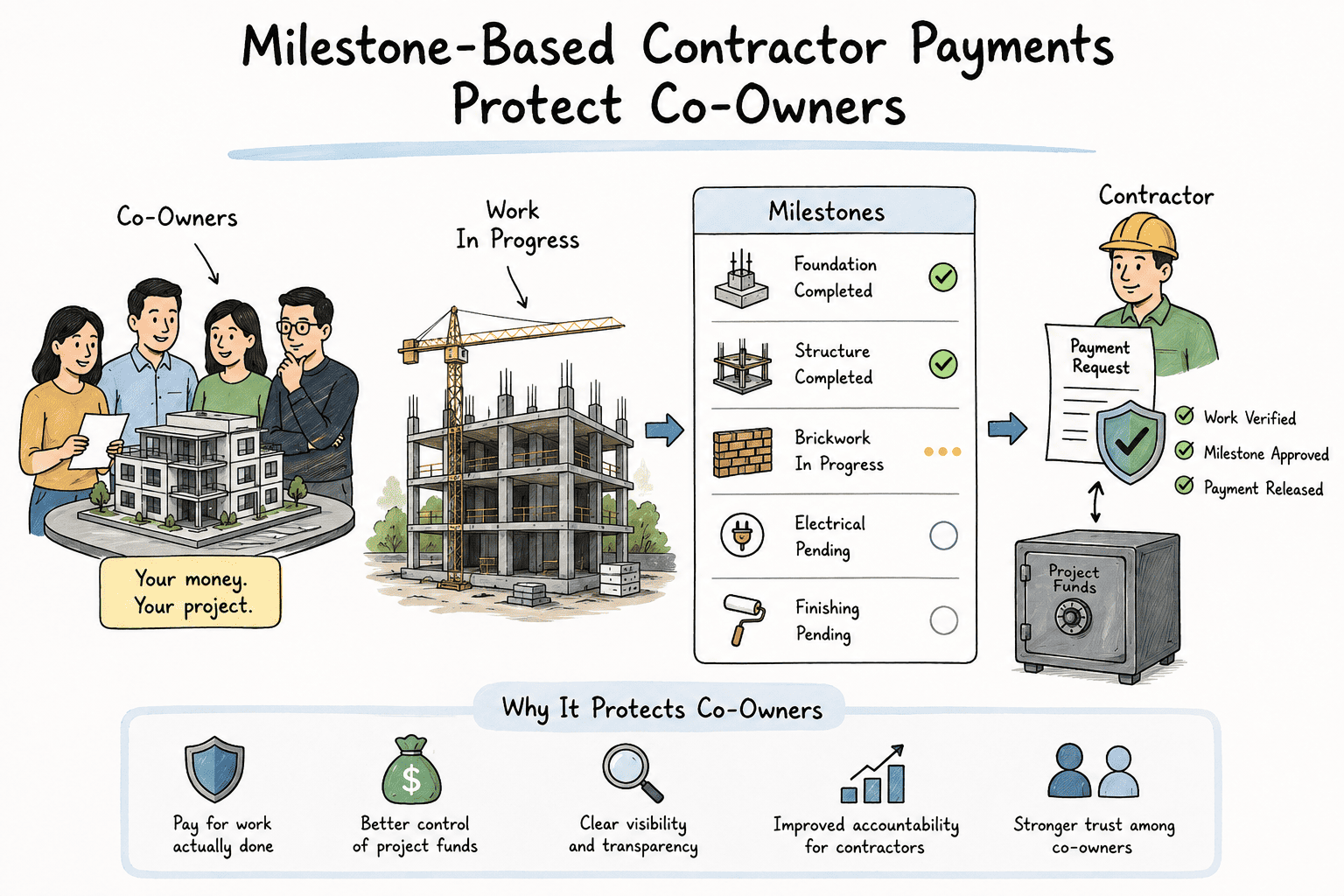
Hiring a contractor is one of the biggest financial decisions in a construction project.
For a co-owned project, the stakes are even higher.
The money being spent doesn't belong to one person. It belongs to a group of co-owners who expect the project to be managed responsibly.
That creates an important question:
When should a contractor actually be paid?
A common approach is to agree on a contract amount and then make payments according to a simple schedule.
But there is a stronger approach:
Connect contractor payments to verified construction milestones.
Instead of paying simply because a date has arrived or an invoice has been submitted, payment becomes connected to actual work completed.
This creates a financial control mechanism that protects both the project and its co-owners.
What Is a Milestone-Based Contractor Payment?
A milestone-based payment is a payment that becomes eligible only after a defined piece of work has been completed and approved.
For example, suppose a contractor is responsible for structural work.
Instead of:
"Pay $100,000 every month."
the contract could be divided into measurable milestones:
| Milestone | Payment |
|---|---|
| Foundation completed | $50,000 |
| Ground floor structure completed | $75,000 |
| First floor structure completed | $75,000 |
| Second floor structure completed | $75,000 |
| Final structural work | $25,000 |
| Total | $300,000 |
The contractor doesn't simply receive the full contract value because the project has reached a particular date.
Payment is associated with defined deliverables.
Why This Matters in a Co-Owned Project
Consider a project with 20 co-owners.
The group has invested a significant amount of money into construction.
A contractor requests a large payment.
The finance manager approves it.
But the work is only partially complete.
What happens if the contractor then becomes delayed?
The project has already released money for work that hasn't been fully delivered.
Recovering that money or forcing the contractor to complete the work can become difficult.
A milestone-based payment structure provides a stronger financial safeguard.
The principle is simple:
Work first. Verification second. Payment third.
The Three-Step Payment Gate
A practical milestone payment process can follow three stages:
1. Complete
The contractor or site manager reports that the milestone has been completed.
2. Approve
An authorized person verifies the work and approves the milestone.
3. Release
The payment is explicitly released after approval.
So the flow becomes:
Work Completed → Verified → Approved → Payment Released
This creates a clear separation between reporting progress and releasing money.
Step 1: Define the Work Clearly
The first requirement for milestone-based payments is a clear definition of the work.
A milestone shouldn't simply say:
"Structural work."
That's too broad.
A better milestone might specify:
"Complete reinforced concrete structure for the ground floor, including columns, beams and slab, according to the approved drawings."
The more clearly the deliverable is defined, the easier it becomes to determine whether it has actually been completed.
What a Good Milestone Should Define
Depending on the project, a milestone can include:
- Name
- Description
- Expected completion date
- Percentage of the work package
- Payment amount
- Dependencies
- Completion criteria
- Responsible parties
This gives everyone a common understanding of what the contractor is expected to deliver.
Step 2: Assign a Value to the Milestone
Each milestone should have a financial value.
Suppose a contractor has a $500,000 work package.
The project could divide it into:
| Milestone | Weight | Amount |
|---|---|---|
| Site preparation | 10% | $50,000 |
| Foundation | 20% | $100,000 |
| Ground floor structure | 20% | $100,000 |
| Upper structure | 30% | $150,000 |
| Finishing work | 20% | $100,000 |
| Total | 100% | $500,000 |
Now the project has a clear relationship between the contractor's scope and the payment structure.
This also makes the financial impact of progress easier to understand.
Step 3: Record Progress
Construction progress should be recorded rather than communicated only through informal messages.
For example:
Foundation milestone
Progress: 100%
Ground floor structure
Progress: 70%
Upper structure
Progress: 20%
This provides a historical record of how the contractor's reported progress changed over time.
Progress logs are particularly useful when questions arise later.
For example:
"When did the contractor report that this work was 70% complete?"
A structured progress history can answer that question.
Step 4: Verify the Work
Reported completion isn't necessarily the same as verified completion.
The contractor may say:
"The milestone is complete."
The project should still have a verification step.
An authorized site manager or responsible person can inspect the work and confirm whether the defined deliverables have actually been completed.
This creates an important distinction:
Reported completion ≠ Approved completion
The difference protects the project's finances.
Step 5: Approve the Milestone
Once the work has been verified, an authorized person should approve the milestone.
This is particularly important in a co-owned project because not every user should necessarily have permission to release project funds.
A project might have different roles such as:
- Site Supervisor
- Finance Manager
- Committee Member
- Project Administrator
- Authorized Co-Owner
Each role can have different responsibilities.
For example:
Site Supervisor: confirms construction progress.
Authorized Approver: approves the completed milestone.
Finance Manager: processes or releases the payment.
This separation creates stronger internal controls.
Step 6: Release the Payment
Only after the milestone has been completed and approved should the payment become eligible for release.
This creates a clean financial sequence:
Contract → Work Package → Milestone → Completion → Approval → Payment
The payment record can then be connected back to the relevant contractor and milestone.
That means the project can later answer:
"Why was this payment made?"
with a clear chain of information.
Why Paying Based on Dates Can Be Risky
Time-based payment schedules are common.
For example:
"The contractor will receive $50,000 every month."
The problem is that time passing doesn't necessarily mean work has been completed.
Construction can be delayed because of:
- Material shortages
- Weather
- Labour problems
- Design changes
- Permits
- Site conditions
- Contractor performance
If payment is automatically tied to the calendar, the project may continue paying even when progress is behind schedule.
A milestone-based approach creates a stronger connection between money and actual deliverables.
Why Paying Only Against Invoices Is Also Not Enough
An invoice tells the project that the contractor is requesting payment.
It doesn't necessarily prove that the corresponding work has been completed.
For example:
Invoice: $40,000
The important question isn't only:
"Did we receive the invoice?"
It is:
"What work does this invoice represent, and has that work been completed and approved?"
This is why invoice processing and construction verification should work together.
Work Packages Make Contractor Management Easier
For larger projects, it can be useful to structure contractor agreements as work packages.
A work package can define:
- Vendor
- Scope of work
- Billing method
- Contract value
- Payment terms
- Retention percentage
- Milestones
- Progress
- Payment history
For example:
Electrical Work Package
Contractor: ABC Electrical Ltd.
Contract value: $120,000
Billing: Milestone-based
Milestones:
- Conduit installation — $30,000
- Wiring completed — $35,000
- Distribution panels installed — $25,000
- Fixtures installed — $20,000
- Testing and handover — $10,000
Now the entire contractor relationship is structured around the actual work.
Retention Can Add Another Layer of Protection
Some construction contracts retain a percentage of payment until final completion or another contractual condition is satisfied.
For example:
Milestone value: $50,000
Retention: 5%
The contractor may receive:
$47,500
while:
$2,500
remains retained according to the contract terms.
Retention can provide an additional financial incentive for contractors to complete outstanding work and resolve defects.
The exact retention rules should always follow the project's contract.
Milestone Payments Improve Cash-Flow Planning
Milestone-based payments aren't only useful for protecting against incomplete work.
They also make cash-flow planning easier.
Suppose the upcoming milestones are:
| Milestone | Expected Payment | Expected Date |
|---|---|---|
| Foundation | $75,000 | September 10 |
| Ground Floor | $100,000 | October 15 |
| First Floor | $100,000 | November 20 |
The project now has visibility into upcoming financial commitments.
That information can be used to plan co-owner contribution schedules.
This creates another useful connection:
Construction Milestone → Contractor Payment → Funding Requirement → Co-Owner Contributions
The project can anticipate its funding needs rather than waiting until a contractor payment is suddenly due.
Milestone Payments Create Better Accountability
A milestone system creates accountability for multiple parties.
Contractor
The contractor knows exactly what must be completed to become eligible for payment.
Site Manager
The site manager has a clear basis for reporting progress.
Approver
The approver has a defined deliverable to verify.
Finance Manager
The finance manager has a documented basis for releasing the money.
Co-Owners
Co-owners can understand why project funds were released.
Everyone has a clearer role.
What Happens When a Milestone Is Delayed?
Construction delays happen.
A milestone-based system makes delays visible.
Suppose:
Expected completion: October 10
Current date: October 20
Progress: 70%
The project can immediately identify that the milestone is behind schedule.
More importantly, the related payment can remain unreleased until the required completion and approval conditions are satisfied.
This creates a financial consequence for delayed work without requiring the project to discover the problem after the money has already been spent.
What If the Scope Changes?
Construction projects often change.
A contractor may discover an unexpected site condition.
The client may change the design.
Additional work may become necessary.
This is where a formal change process becomes important.
The original milestone shouldn't simply be edited without explanation.
A change can instead go through a structured change request:
Change Proposed → Reviewed → Approved/Rejected → Contract or Scope Updated
This preserves the history of the original agreement.
It also prevents informal scope changes from silently increasing the project's financial commitments.
Why an Audit Trail Matters
Suppose a milestone was originally worth $50,000.
Later, the payment amount becomes $65,000.
A co-owner may reasonably ask:
"Why did the amount change?"
A trustworthy system should be able to show the history.
For example:
Original milestone value: $50,000
Change: Additional approved scope
New value: $65,000
Change request: Approved
Approved by: Authorized user
Date: Recorded
This is much stronger than simply changing a number in a spreadsheet.
The history explains what changed and why.
Milestone-Based Payments Don't Eliminate Risk
No payment system can eliminate every construction risk.
A contractor can still perform poorly.
A milestone can be incorrectly approved.
A project can encounter unexpected costs.
The goal is to reduce avoidable risk and create stronger controls.
Milestone-based payments help by ensuring that:
- Work is clearly defined
- Progress is recorded
- Completion is verified
- Approval is explicit
- Payment is connected to the approved work
- Changes have a documented process
These controls make financial management more disciplined.
How Co Build Manager Handles Contractor Work Packages
Co Build Manager uses a Work Package structure for vendor and contractor management.
A work package can define:
- Scope of work
- Billing method
- Contract value
- Payment terms
- Retention percentage
- Vendor
- Milestones
- Progress history
Each work package can then be broken into individual milestones.
The platform's payment gate follows the principle:
Complete → Approve → Release
Progress logs preserve the history of reported completion, while contractor payments can be associated with the relevant work package and milestone.
This creates a structured relationship between construction activity and project finances.
A Better Way to Think About Contractor Payments
The traditional way of thinking about contractor payment is:
"The contractor submitted an invoice, so we need to pay it."
A stronger approach is:
"A defined piece of work was completed, verified, approved, and is now eligible for payment."
That small change in thinking can make a significant difference.
The invoice becomes part of the payment process rather than the sole reason for payment.
The Bigger Picture
Milestone-based contractor payments are not an isolated financial feature.
They are part of a larger project-management process.
A well-structured construction project connects:
Budget
↓
Work Package
↓
Milestone
↓
Progress
↓
Verification
↓
Approval
↓
Payment
↓
Actual Cost
This creates a feedback loop between what the project planned, what the contractor delivered, and what the project actually spent.
That information can then be used to improve future funding and cost forecasts.
Conclusion
For a co-owned construction project, contractor payments should be more than simple financial transactions.
Every payment represents money contributed by multiple people and should have a clear connection to the work being performed.
Milestone-based payments provide that connection.
By defining work packages, breaking them into measurable milestones, recording progress, verifying completion, obtaining approval, and releasing payment only after the required conditions are met, a project can create stronger financial and operational control.
The principle is simple:
Don't pay only because an invoice arrived. Pay because the agreed work has been completed, verified, and approved.
For co-owners investing significant amounts of money into a shared construction project, that distinction can make the difference between simply tracking payments and actually controlling them.
Share this article
Found this helpful? Share it with your team or co-owners.

Samia Nusrat
Lead Architect & Real Estate Strategist
Samia is a visionary architect and real estate strategist with over 15 years of experience shaping the urban landscape of Bangladesh. Specializing in sustainable development, modern commercial spaces, and urban compliance, she has successfully led the design and execution of landmark projects across Dhaka and Chittagong. At CoBuild Manager, Nusrat shares her expertise on innovative building materials, smart city planning, and blending modern architectural aesthetics with functional structural engineering.