A construction project rarely goes exactly according to the original budget.
Material prices change.
Labour costs increase.
Work takes longer than expected.
Contractors request additional payments.
Designs change.
Unexpected site conditions appear.
None of these things automatically means a project is being poorly managed.
The real problem is discovering the cost overrun after most of the money has already been spent.
For a co-owned construction project, that can be especially painful.
When the budget falls short, the project may need another funding request from the co-owners. If the additional requirement comes unexpectedly, it can create financial pressure, disagreement, and a loss of confidence in the project's management.
The better approach is to identify the warning signs early.
Spending Less Than the Budget Doesn't Always Mean You're on Track
Consider a project with a structural-work budget of:
$300,000
So far, the project has spent:
$180,000
At first glance, everything looks fine.
There is still:
$120,000 remaining
But there is another important question:
How much of the work has actually been completed?
Suppose only 40% of the structural work is complete.
Now the picture looks very different.
The project has already consumed 60% of the budget while completing only 40% of the work.
That could be an early warning sign.
This is why simply comparing budget vs. actual spending isn't enough.
You also need to consider progress.
Budget, Actual Cost, and Progress Tell Different Stories
These three numbers answer three different questions.
Budget
How much did we originally plan to spend?
Actual Cost
How much have we spent so far?
Progress
How much of the planned work has actually been completed?
Looking at all three together provides much more useful information.
For example:
| Metric | Value |
|---|---|
| Budget | $300,000 |
| Actual Cost | $180,000 |
| Remaining Budget | $120,000 |
| Construction Progress | 40% |
The project is only 40% complete but has already used 60% of its budget.
That doesn't prove there will be an overrun.
But it is a clear signal that the project deserves closer attention.
Why Cost Overruns Are Often Discovered Too Late
In many construction projects, financial reporting focuses on what has already happened.
Someone asks:
"How much have we spent?"
The answer comes back:
"$500,000."
Then another month passes.
The project spends another $100,000.
The total becomes:
"$600,000."
The problem is that neither number tells you what the final cost is likely to be.
A project can be under budget today and still be heading toward a significant overrun.
What co-owners really need is not just historical spending.
They need forward-looking information.
What Is Cost Forecasting?
Cost forecasting means estimating what the project is likely to cost when it is finished based on current information.
Instead of asking:
"How much have we spent?"
the project also asks:
"Based on our current progress and spending efficiency, how much are we likely to spend by the end?"
This projected final cost is commonly referred to as:
Estimated At Completion (EAC)
EAC can provide an early warning when the expected final cost is moving beyond the approved budget.
What Does EAC Mean for a Co-Build Project?
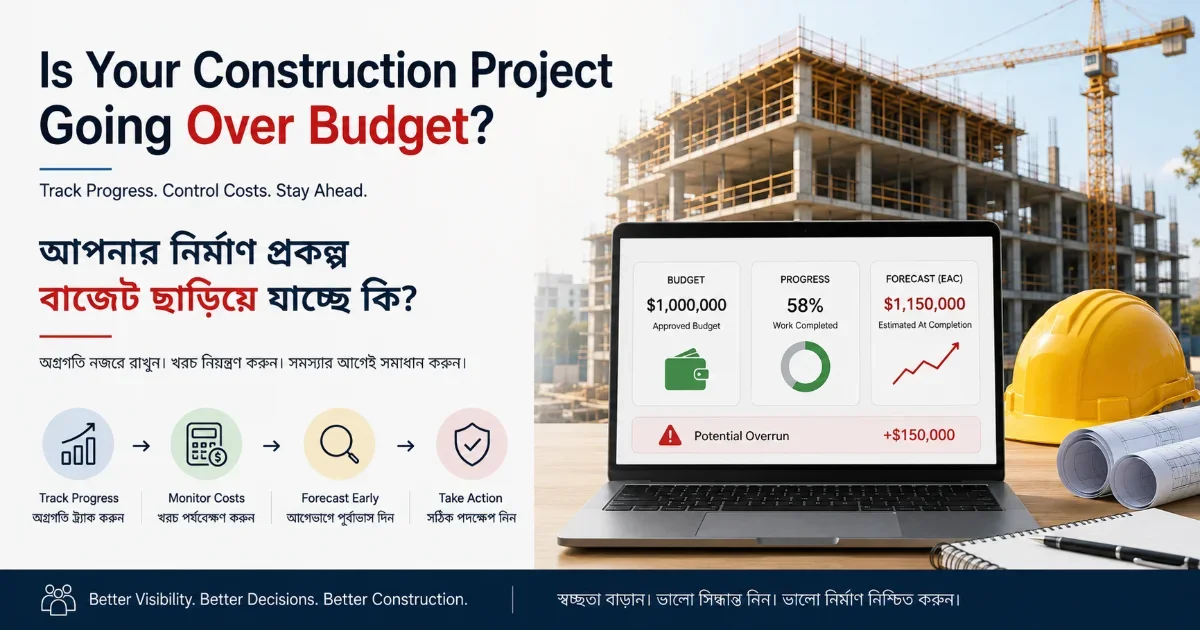
Imagine the project has:
Approved Budget: $1,000,000
So far:
Actual Cost: $500,000
At first glance, the project appears to be exactly halfway through its budget.
But suppose the construction progress indicates that the project is further behind than expected.
The current spending efficiency suggests that the remaining work will cost more than originally planned.
The forecast might now show:
Estimated At Completion: $1,150,000
That means the project may eventually require:
$150,000 more than the approved budget
This is valuable information even if the project hasn't spent that additional money yet.
It gives the co-owners time to investigate and respond.
Early Warning Is More Valuable Than a Final Report
Imagine discovering a $150,000 budget shortfall when the project is 95% complete.
There aren't many options left.
The group may simply have to raise the additional money.
Now imagine identifying the same forecast when the project is only 50% complete.
The group has more choices.
It can investigate:
- Which construction phase is causing the problem?
- Which costs are higher than expected?
- Can the remaining work be renegotiated?
- Can specifications be adjusted?
- Are contractor costs increasing?
- Are materials being purchased efficiently?
- Is the original budget still realistic?
The earlier the warning appears, the more opportunities the project has to respond.
Not Every Budget Variance Is a Problem
A higher-than-expected cost doesn't automatically mean something is wrong.
For example, a project may intentionally spend more during one phase and less during another.
Suppose:
| Phase | Budget | Actual |
|---|---|---|
| Foundation | $100,000 | $115,000 |
| Structure | $300,000 | $285,000 |
| Finishing | $200,000 | $180,000 |
The foundation is over budget.
But the project may still be within the overall budget.
This is why financial analysis should happen at both:
Project level
and
Milestone or phase level
A problem in one phase can be identified before it becomes a project-wide problem.
Construction Milestones Make Cost Analysis More Useful
A project timeline can be divided into milestones such as:
- Site preparation
- Foundation
- Ground floor
- Upper floors
- Brickwork
- Electrical
- Plumbing
- Flooring
- Finishing
Each milestone can have:
- Planned dates
- Progress
- Budget
- Actual expenditure
- Assigned responsibility
Now financial and physical progress can be viewed together.
For example:
Foundation
Budget: $120,000
Actual: $115,000
Progress: 95%
This looks relatively healthy.
Structural Work
Budget: $300,000
Actual: $240,000
Progress: 55%
This deserves more attention.
The project has already spent 80% of the milestone budget while completing only 55% of the work.
That may indicate a potential overrun.
Progress Needs to Be Measurable
A common problem with construction reporting is vague progress updates.
For example:
"The building is progressing well."
That's not very useful.
A structured milestone system can provide more meaningful information:
Structural Work — 65% complete
Expected completion: October 30
Current status: On schedule
Budget: $300,000
Actual cost: $210,000
Now co-owners have something they can actually evaluate.
The financial and physical information can be viewed together rather than as separate conversations.
What Is Cost Performance Index?
For more advanced forecasting, construction projects can use Cost Performance Index (CPI).
CPI compares the value of completed work with the actual cost incurred.
In simple terms:
CPI = Earned Value ÷ Actual Cost
A CPI of:
1.00 means spending is broadly aligned with the value of completed work.
A CPI below:
1.00 indicates cost inefficiency.
A CPI above:
1.00 indicates better cost efficiency than the baseline.
The exact interpretation depends on the project's measurement method and data quality, but the concept is useful for identifying cost performance trends.
Why CPI Can Matter for Forecasting
Suppose a project has:
Earned Value: $400,000
Actual Cost: $500,000
The CPI is:
0.80
This means the project is achieving only $0.80 of planned value for every $1.00 spent under the measurement being used.
If that efficiency continues, the final project cost may be significantly higher than the original budget.
That's where EAC becomes useful.
Instead of waiting until the end, the project can use current performance to estimate where the final cost may land.
Forecasting Is Not About Predicting the Future Perfectly
Cost forecasting should not be treated as a crystal ball.
Construction conditions can change.
A forecast is an estimate based on the information available today.
Its value is not that it predicts the exact final number.
Its value is that it provides an early signal.
For example:
Original Budget: $2,000,000
Current Forecast: $2,180,000
That $180,000 difference should trigger a conversation.
Maybe the forecast is temporary.
Maybe a contractor change caused it.
Maybe material prices increased.
Maybe the original budget was unrealistic.
Whatever the reason, the project now knows there is something worth investigating.
Cost Forecasting Can Improve Co-Owner Funding Decisions
This is especially important in a co-owned project.
Suppose the project originally expected to require another:
$200,000
from the co-owners.
Later, updated forecasting suggests that the remaining work may require:
$300,000
Now the group has an opportunity to prepare.
Instead of suddenly announcing:
"We need another $100,000."
the project can provide context:
- Current budget
- Actual spending
- Remaining work
- Forecasted final cost
- Expected funding gap
- Reason for the variance
This makes additional funding requests much easier to understand.
Connect Forecasting to Deposit Schedules
The connection between forecasting and co-owner contributions is particularly important.
Suppose the current project forecast identifies an additional funding requirement.
That information can feed into a future deposit schedule.
The process becomes:
Construction Progress
↓
Actual Costs
↓
Cost Forecast
↓
Funding Requirement
↓
Deposit Schedule
↓
Co-Owner Contributions
This is much stronger than discovering a funding shortage after a contractor sends an urgent payment request.
Vendor Performance Can Affect the Forecast
Contractors are often a major component of construction costs.
A project may have a contractor with:
Contract Value: $500,000
But the contract isn't the only thing that matters.
The project should also consider:
- Work completed
- Payments made
- Remaining milestones
- Approved changes
- Additional scope
- Delays
- Retention
- Expected remaining cost
If a contractor is consistently behind schedule or requesting additional work, the project's forecast may need to change.
This is another reason why contractor work packages and milestone tracking are valuable.
Change Requests Should Be Included in the Financial Picture
Construction changes are common.
A project may approve:
- Additional work
- Design changes
- Material substitutions
- Scope increases
- Contractor changes
These changes can affect the final cost.
A formal change request process helps ensure that the financial impact of a change isn't hidden inside a spreadsheet or buried in a chat message.
The project should be able to understand:
Original Budget
→ Approved Change
→ Revised Budget
→ Actual Cost
→ Updated Forecast
This creates a much clearer financial history.
What a Healthy Project Dashboard Should Show
A useful construction dashboard shouldn't overwhelm co-owners with hundreds of numbers.
It should highlight the information that matters.
For example:
Project Budget
$2,000,000
Actual Cost
$1,050,000
Construction Progress
58%
Forecasted Final Cost
$2,080,000
Forecast Variance
+$80,000
Current Status
Forecast requires attention
This immediately tells the group that the project may be heading above budget.
The detailed reports can then explain why.
Look at Trends, Not Just One Snapshot
One forecast isn't enough.
What matters is how the forecast changes over time.
For example:
| Month | EAC |
|---|---|
| January | $1,950,000 |
| February | $1,980,000 |
| March | $2,020,000 |
| April | $2,080,000 |
The project is gradually moving further away from its original budget.
That trend may be more important than the current $80,000 variance itself.
A rising EAC can be an early warning that spending efficiency or project assumptions need attention.
Transparency Helps Co-Owners Make Better Decisions
Most co-owners don't need to become construction accountants.
They need understandable information.
Instead of giving everyone a complicated financial model, the project can communicate:
"The project is 58% complete. We have spent $1.05 million against the $2 million budget. Based on current spending efficiency, the projected final cost is $2.08 million. The main variance is coming from structural work and approved scope changes."
That's much easier to understand.
It also gives co-owners enough context to ask better questions.
How Co Build Manager Helps Monitor Cost and Progress
Co Build Manager connects construction milestones with financial information.
The platform provides:
- Project milestone timelines
- Gantt-style construction views
- Milestone progress tracking
- Budget allocation by milestone
- Actual expenditure by milestone
- Milestone financial reports
- Cost Performance Index
- Estimated At Completion forecasting
- Vendor work packages
- Contractor milestone tracking
- Deposit schedules linked to milestones
This creates a connection between what is happening physically on the construction site and what is happening financially.
A co-owner can therefore see not only:
"How much have we spent?"
but also:
"What have we accomplished with that spending, and where are we likely to end up?"
The Difference Between Reporting and Management
A spreadsheet can tell you what happened.
A good project management system should help you understand what is happening and what may happen next.
There is an important difference.
Reporting
"We have spent $1 million."
Management
"We have spent $1 million, completed 55% of the work, and our current spending efficiency suggests the project may finish $120,000 above budget."
The second statement gives the project something it can act on.
That is the real value of forecasting.
Don't Wait Until the Money Is Gone
By the time a project officially announces:
"We are over budget."
the problem may already be difficult to solve.
Good construction financial management looks for warning signs earlier.
It compares:
Planned Cost
with
Actual Cost
and
Physical Progress
and
Expected Final Cost
When these numbers are reviewed together, co-owners have a much clearer understanding of the project's financial health.
Conclusion
A construction project can be under its budget today and still be heading toward a significant overrun tomorrow.
That's why tracking total expenses alone isn't enough.
Co-owners need to understand how much has been spent, how much work has been completed, and what the project is likely to cost when finished.
Milestone-level budgets, actual expenditure, progress tracking, and cost forecasting provide that visibility.
The most important number isn't always:
"How much have we spent?"
Sometimes the more important question is:
"Based on what we've spent and what we've completed so far, where are we likely to finish?"
When a project can answer that question early, co-owners have time to investigate problems, adjust plans, control costs, and prepare funding decisions.
For a shared construction project, early visibility is far more valuable than a perfect explanation after the budget has already been exceeded.
Share this article
Found this helpful? Share it with your team or co-owners.

Tariqul Islam
Real Estate Expert
Tariqul Islam brings over 20 years of hands-on expertise in the Bangladeshi construction and real estate sectors. Having spearheaded numerous large-scale commercial and residential projects across Dhaka and major divisions, he specializes in lean project management, supply chain optimization, and sustainable building practices. At CoBuild Manager, Tariqul shares his deep industry insights to help developers and contractors streamline their workflows and build smarter.