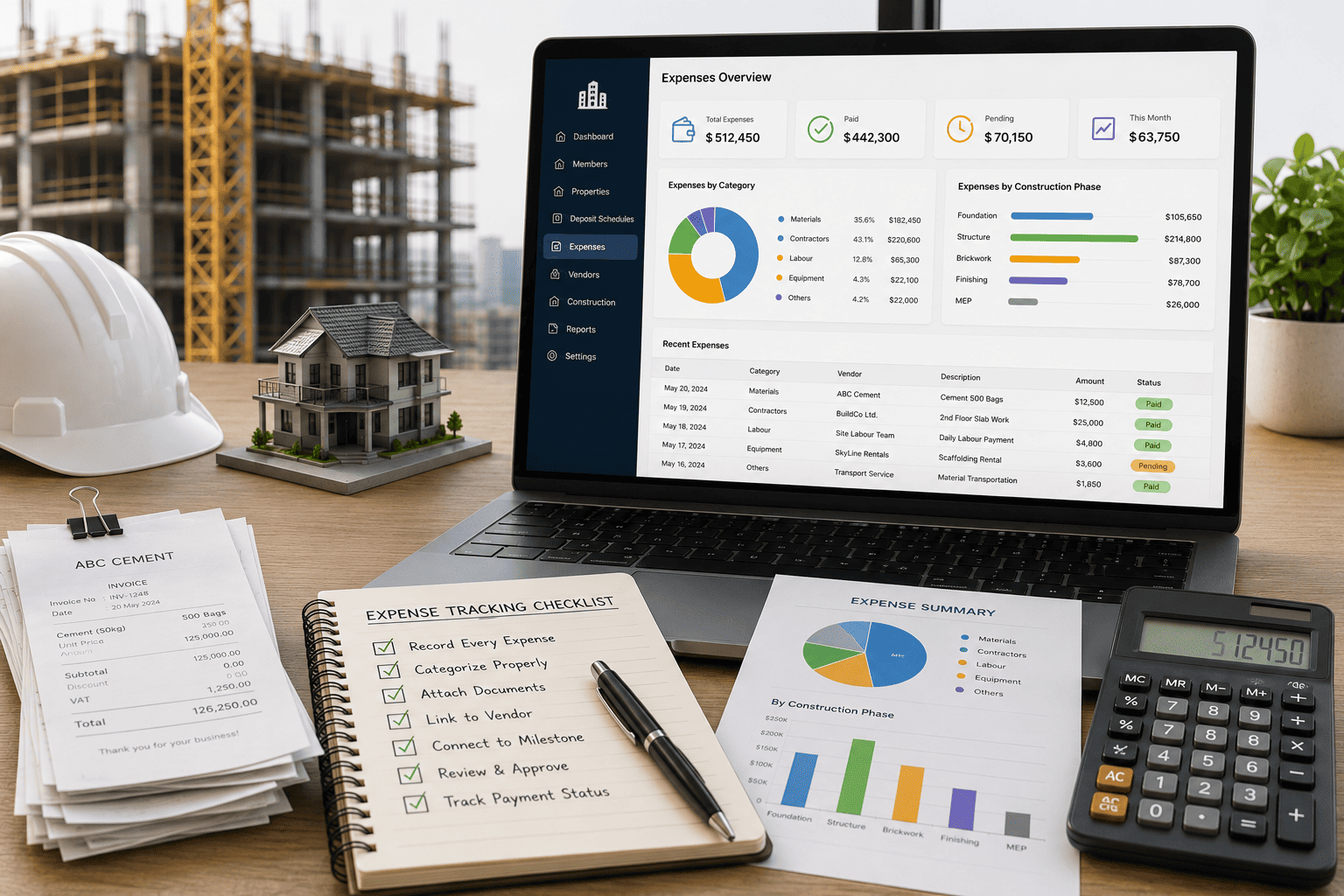
When one person builds a property, tracking expenses can be relatively straightforward.
There is usually one owner, one primary source of funding, and one person responsible for monitoring where the money goes.
A co-owned construction project is different.
There may be dozens of co-owners contributing money, multiple contractors working at the same time, daily labour payments, material purchases, petty cash expenses, professional fees, and payments from different project bank accounts.
Someone eventually asks a very simple question:
"How much have we spent, and where did the money go?"
A well-managed project should be able to answer that question quickly.
Why Construction Expense Tracking Is Different
Construction expenses are not a single type of transaction.
A project may spend money on:
- Building materials
- Contractors
- Subcontractors
- Labour
- Equipment
- Transportation
- Professional services
- Permits and fees
- Site expenses
- Petty cash
- Utilities
- Other project-related costs
These expenses also happen at different stages of construction.
A concrete purchase may belong to the foundation phase.
A contractor payment may belong to structural work.
Electrical materials may belong to a later phase.
Without proper categorization, the project can know its total spending without actually understanding its spending.
And knowing where the money went is often more important than knowing only the total.
1. Record Every Expense in One Place
The first principle of good expense management is simple:
Every project expense should have a structured record.
At minimum, an expense record should contain information such as:
- Expense date
- Amount
- Expense category
- Vendor or payee
- Payment status
- Bank account or cash source
- Description
- Supporting documents
- Relevant project phase
This creates a consistent financial record.
Instead of having some expenses in a spreadsheet, others in WhatsApp, and receipts in someone's drawer, the project has one central source of information.
Why Centralization Matters
Imagine that a co-owner asks:
"How much have we spent on materials?"
If material purchases are recorded consistently, the answer can be produced immediately.
If some purchases are in a spreadsheet, some are in WhatsApp messages, and others are only represented by paper receipts, someone has to manually reconstruct the number.
That takes time and creates opportunities for mistakes.
A centralized expense record makes reporting much easier.
2. Categorize Expenses Properly
Simply recording an amount isn't enough.
Suppose the project has spent $500,000.
That number alone doesn't tell the co-owners much.
They may want to know:
- How much went to materials?
- How much went to labour?
- How much went to contractors?
- How much was spent on equipment?
- How much was spent on professional services?
Expense categories turn a large total into useful information.
For example:
| Expense Category | Amount |
|---|---|
| Materials | $180,000 |
| Contractors | $220,000 |
| Labour | $65,000 |
| Equipment | $20,000 |
| Professional Services | $15,000 |
| Total | $500,000 |
Now the project has a much clearer financial picture.
Categories Should Be Consistent
The project should define its expense categories clearly.
For example, one person shouldn't record an expense as:
"Concrete"
while another records the same type of expense as:
"Building Material"
and another uses:
"Construction Materials."
A consistent categorization system makes reports much more useful.
3. Record the Vendor or Payee
Knowing the category is useful.
Knowing who received the money is even better.
For example:
| Date | Category | Vendor | Amount |
|---|---|---|---|
| Aug 2 | Materials | ABC Cement | $12,000 |
| Aug 4 | Labour | Site Labour Team | $4,500 |
| Aug 6 | Contractor | BuildCo Ltd. | $25,000 |
This makes the expense history much easier to understand.
It also helps answer questions such as:
"How much have we paid this contractor?"
or:
"How much did we spend with this supplier?"
Vendor-level tracking becomes particularly valuable when a project has multiple contractors and suppliers.
4. Separate Contractor Payments From General Expenses
A contractor payment isn't always just another expense.
A contractor may have:
- A defined scope
- A contract value
- Payment terms
- Multiple work packages
- Milestones
- Progress percentages
- Invoices
- Retention amounts
- Approval requirements
For that reason, contractor payments should ideally be connected to the contractor's work rather than existing as an isolated transaction.
For example:
Vendor
↓
Work Package
↓
Milestone
↓
Completion
↓
Approval
↓
Payment
This gives the project much more context around the expense.
5. Connect Expenses to Construction Milestones
One of the most useful improvements to expense tracking is connecting financial expenditure to construction progress.
Suppose a project has these milestones:
- Foundation
- Ground Floor Structure
- First Floor Structure
- Brickwork
- Electrical
- Plumbing
- Finishing
The project might spend $100,000 on the foundation.
That expense should be associated with the relevant construction phase whenever appropriate.
Now the project can report:
Foundation Budget: $120,000
Foundation Actual Cost: $105,000
This is much more informative than simply saying:
Total Project Expenses: $500,000
Why Phase-Level Spending Matters
A project can be within its total budget while still overspending significantly on one phase.
For example:
| Phase | Budget | Actual |
|---|---|---|
| Foundation | $120,000 | $105,000 |
| Structure | $300,000 | $340,000 |
| Brickwork | $150,000 | $140,000 |
| Electrical | $100,000 | $70,000 |
The total picture might look acceptable.
But structural work is already over budget.
That early visibility gives the project an opportunity to investigate the reason before the problem becomes larger.
6. Track Purchase Requests Before Expenses
Another important distinction is between requesting a purchase and recording the resulting expense.
Suppose the site manager needs $15,000 worth of materials.
The project could follow this process:
Purchase Request
↓
Review
↓
Approval
↓
Purchase
↓
Expense
This creates a record of how spending was authorized.
Without such a process, expenses can sometimes appear only after money has already been spent.
A purchase-request workflow gives the project an opportunity to review the planned expenditure before the financial commitment occurs.
7. Keep Petty Cash Separate
Not every construction expense is paid directly from a bank account.
Construction sites often use petty cash for small, immediate expenses.
For example:
- Small materials
- Transportation
- Site supplies
- Minor repairs
- Worker-related expenses
Petty cash should not become a black hole in the project's financial records.
If $5,000 is transferred from the project bank account into petty cash, that transfer should be recorded.
Individual petty cash expenses should then be recorded separately.
The project should be able to follow:
Bank Account → Petty Cash → Individual Expenses → Remaining Cash
If unused cash is returned to the bank, that return should also be recorded.
This creates a complete trail of physical cash.
8. Record Which Bank Account Paid the Expense
A project may have more than one bank account.
If expenses are paid from different accounts, the financial system should preserve the source account.
For example:
| Expense | Amount | Paid From |
|---|---|---|
| Cement | $12,000 | Project Bank A |
| Labour | $5,000 | Project Bank B |
| Contractor | $25,000 | Project Bank A |
This helps with reconciliation.
It also makes bank statement imports and financial reporting more accurate.
9. Keep Supporting Documents With the Expense
A financial amount without supporting documentation can be difficult to verify later.
Depending on the expense, supporting documents may include:
- Invoice
- Receipt
- Purchase order
- Contractor document
- Payment confirmation
- Bank statement
- Approval record
The goal is not to create unnecessary paperwork.
The goal is to make the financial record understandable.
If someone asks:
"Why was $25,000 paid to this vendor?"
the project should ideally be able to show the relevant supporting information without searching through several applications.
10. Track Payment Status
An expense may be recorded before the actual payment is completed.
For example:
Invoice amount: $30,000
The project may record the expense while the payment is still pending.
This makes it useful to distinguish between statuses such as:
- Pending
- Approved
- Partially paid
- Paid
- Cancelled
This provides a clearer view of both committed and completed spending.
Why Pending Expenses Matter
Suppose the project has:
Current cash balance: $200,000
But there are:
Approved pending payments: $80,000
The project should not assume that the entire $200,000 is freely available.
Understanding upcoming financial obligations is important for cash-flow management.
11. Compare Actual Expenses With the Budget
Expense tracking becomes significantly more valuable when connected to the project budget.
Suppose a project has allocated:
$250,000 for structural work.
After several weeks:
Actual spending: $190,000
At first glance, the project still appears to have $60,000 available.
But what if the structural work is only 60% complete?
That could be a warning sign.
The project should consider not only:
Budget vs Actual
but also:
Budget vs Actual vs Progress
This provides a much better indication of whether spending is under control.
12. Look at Spending Trends, Not Just Totals
A total expense figure tells you what has already happened.
A trend can help you understand what may happen next.
For example:
| Month | Expenses |
|---|---|
| January | $50,000 |
| February | $65,000 |
| March | $85,000 |
| April | $110,000 |
The project is spending more each month.
That may be completely normal as construction activity increases.
But it could also indicate that spending is accelerating faster than planned.
Tracking expenses over time allows the project team to identify changes in spending patterns earlier.
13. Make Financial Information Accessible to Co-Owners
Financial transparency doesn't mean every member should be allowed to edit every financial record.
It means authorized co-owners should have appropriate visibility.
A co-owner may want to see:
- Total project spending
- Recent expenses
- Spending by category
- Their own contributions
- Project balance
- Relevant financial reports
At the same time, financial managers may have additional permissions to record or approve transactions.
This is where role-based access becomes important.
The project should distinguish between:
Who can view
and
Who can change.
14. Protect the History of Financial Records
Even authorized users can make mistakes.
Someone might enter the wrong amount.
Someone might update the wrong vendor.
Someone might accidentally modify a payment status.
A robust financial system should therefore preserve the history of important changes.
For example:
Before: $20,000
After: $22,000
Changed by: Authorized user
Timestamp: Recorded
Previous state: Preserved
This is the difference between simply having financial data and having trustworthy financial data.
An audit trail allows the project to reconstruct what happened instead of relying on memory.
15. Generate Reports From the Same Source of Truth
One of the biggest advantages of structured expense tracking is reporting.
The project should be able to generate information such as:
Total Expenses
How much has the project spent?
Expenses by Category
Where is the money going?
Expenses by Vendor
Which suppliers and contractors have received money?
Expenses by Milestone
How much has each construction phase cost?
Budget vs Actual
Are costs within the planned budget?
Payment Status
Which expenses are paid or pending?
Cash Position
How much money is currently available?
When these reports are generated from the same underlying records, they remain consistent.
There is no need to maintain separate spreadsheets for every report.
A Practical Expense-Tracking Structure
A useful expense record can be thought of as:
Expense
→ Date
→ Amount
→ Category
→ Vendor
→ Payment Status
→ Bank Account / Cash Source
→ Construction Milestone
→ Supporting Documents
→ Approval
→ Audit History
Not every expense will require every field.
But the structure provides a useful framework for maintaining financial information.
How Co Build Manager Approaches Construction Expenses
Co Build Manager provides a centralized financial system designed specifically for shared construction projects.
The platform supports structured tracking of:
- Expenses
- Vendors
- Purchase requests
- Vendor payments
- Labour costs
- Petty cash
- Bank accounts
- Bank statement imports
- Construction milestones
- Budgets
- Financial reports
Expenses can be associated with the relevant project information so that financial activity isn't isolated from the rest of the construction project.
For example, a vendor payment can be connected to the relevant vendor and work package, while project spending can be analyzed against construction milestones and budgets.
This gives co-owners and project managers a much clearer picture of where project money is going.
From "Where Did the Money Go?" to a Clear Answer
The ultimate goal of expense tracking isn't to create more accounting work.
It is to make the project's financial position understandable.
When expenses are centralized, categorized, connected to vendors and construction phases, and supported by proper documentation, the project can answer important questions quickly.
Instead of:
"I think we spent around $500,000."
the project can say:
"The project has spent $500,000, including $180,000 on materials, $220,000 on contractors, $65,000 on labour, and $35,000 on other project costs."
Instead of:
"I think the contractor has been paid."
the project can show the contractor's payment history.
Instead of:
"Someone probably approved that purchase."
the project can show the approval record.
And instead of:
"The spreadsheet was changed at some point."
the project can show the relevant audit history.
Conclusion
Construction expense tracking becomes challenging when multiple people jointly own and finance the same project.
The project isn't dealing with one type of expense or one payment source. It may have contractors, materials, labour, petty cash, bank transactions, purchase requests and milestone-based spending happening simultaneously.
A reliable system should therefore do more than record numbers.
It should connect:
Expense → Vendor → Payment → Construction Phase → Budget → Documentation → Approval → Audit History
That connection gives co-owners something more valuable than a spreadsheet full of numbers.
It gives them financial visibility and confidence in the information they are looking at.
For a co-owned construction project, every dollar should have a story—and that story should be easy to find.
Share this article
Found this helpful? Share it with your team or co-owners.

Tariqul Islam
Real Estate Expert
Tariqul Islam brings over 20 years of hands-on expertise in the Bangladeshi construction and real estate sectors. Having spearheaded numerous large-scale commercial and residential projects across Dhaka and major divisions, he specializes in lean project management, supply chain optimization, and sustainable building practices. At CoBuild Manager, Tariqul shares his deep industry insights to help developers and contractors streamline their workflows and build smarter.