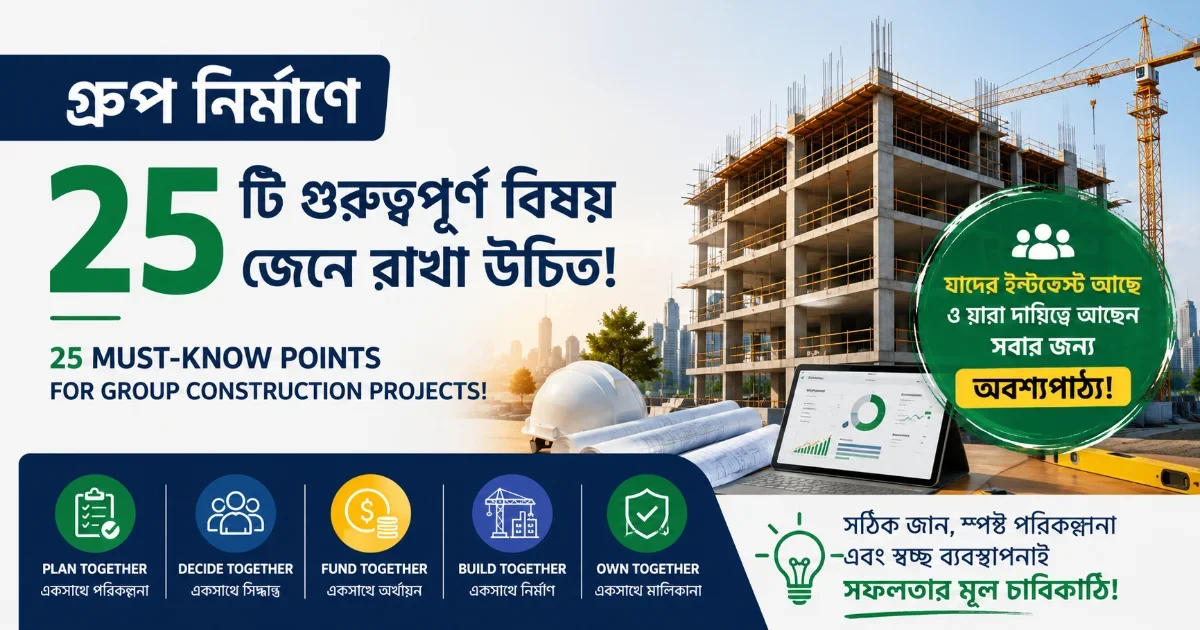
Starting a construction project with a group of people can look simple from the outside.
Buy the land together.
Hire an engineer.
Hire a contractor.
Collect money from everyone.
Build the property.
Split the finished property among the owners.
In reality, it is much more complicated.
The construction itself is only one part of the project.
You are also creating a small organization where multiple people have money invested, different opinions, different expectations, different levels of involvement, and different ideas about how the project should be managed.
I know this from personal experience.
I was part of a 14-member group project where we jointly purchased and registered land. We hired an engineering firm for design and approvals, then hired a civil contractor to execute the construction.
The 14 of us managed the project ourselves.
We collected deposits from the members, paid project expenses, monitored construction progress, communicated with contractors and engineers, and made decisions together.
We completed the project.
But we also made plenty of mistakes.
We spent money that could have been saved.
We sometimes made decisions without having enough information.
We didn't always have a clear process for selecting contractors, approving expenses, managing contributions, tracking progress, or making group decisions.
Looking back, one thing is very clear:
The construction work was not the hardest part. Managing the project as a group was.
If we had known then what we know now, we could have managed the project more efficiently, avoided unnecessary expenses, and reduced a lot of confusion.
That's why I wrote this guide.
If you are planning to build a property with several co-owners—or you have already formed a group and are preparing to start construction—this is the kind of checklist I wish we had before we started.
1. Understand That You Are Starting More Than a Construction Project
The first mistake many groups make is thinking only about the building.
You are actually creating three things at the same time:
A property ownership structure
A financial system
A project management organization
The building is the physical result.
But the other three determine how smoothly you get there.
Before construction begins, your group should answer questions such as:
- Who owns the land?
- What percentage does each person own?
- How will ownership be recorded?
- Who can make decisions?
- How will voting work?
- Who manages the money?
- How will members contribute money?
- Who can approve expenses?
- How will contractors be selected?
- Who will monitor construction?
- How will disputes be handled?
- What happens if someone doesn't pay?
- What happens if someone wants to leave?
If these questions aren't answered early, they will eventually become problems during construction.
2. Define Ownership Clearly
Before spending money on construction, make sure everyone understands exactly what they own.
For example:
| Co-owner | Ownership |
|---|---|
| Member A | 20% |
| Member B | 15% |
| Member C | 10% |
| Member D | 10% |
| Others | 45% |
The actual ownership structure will depend on your project.
The important thing is that it should be clearly documented.
Don't rely on:
"Everyone knows who owns what."
People remember things differently.
Ownership should be based on formal documentation and agreed records.
Also distinguish between:
Land ownership
and
Construction contribution
and
Final allocation of the property
These may be related, but they are not automatically the same thing.
3. Decide How the Group Will Make Decisions
This is one of the most important things to establish before construction starts.
Imagine that your group has 20 members.
One member wants to change the contractor.
Another wants to increase the budget.
Another wants to change the building design.
Who decides?
If the answer is:
"We'll discuss it in the group."
you haven't actually defined a decision-making process.
You need rules.
For example:
- Which decisions require a vote?
- Which decisions can the project manager make?
- Which decisions require committee approval?
- Does every member have one vote?
- Are votes weighted according to ownership?
- What percentage is required for approval?
- Is there a minimum participation requirement?
- Can members delegate their votes?
These rules should exist before a controversial decision occurs.
4. Don't Run the Entire Project Through a WhatsApp Group
This is a mistake many groups make.
WhatsApp is useful for communication.
It is not designed to be your project's financial database, decision register, contractor management system, or document archive.
A typical construction group can quickly accumulate thousands of messages.
Someone asks:
"Did we approve this?"
Then someone has to search through months of conversations.
Someone says:
"I think we agreed to this."
Another person says:
"No, that was a different proposal."
This becomes particularly dangerous when money is involved.
Use chat for quick communication.
But important information should have a proper home:
- Decisions
- Votes
- Meeting minutes
- Expenses
- Deposits
- Contractor agreements
- Purchase requests
- Payments
- Construction milestones
- Documents
- Approvals
A project should not depend on someone's ability to find an old message.
5. Establish a Project Governance Structure
Not everyone needs to manage every detail.
In a larger group, it can be useful to establish defined responsibilities.
For example:
General Members
Participate in major decisions and monitor project information.
Project Committee
Handles important construction and operational decisions.
Finance Team
Manages deposits, payments, expenses, budgets, and financial reporting.
Construction/Technical Team
Coordinates with engineers, contractors, and site personnel.
Project Manager
Handles day-to-day coordination and execution.
The exact structure will depend on the project.
The important principle is:
Responsibility should be assigned, not assumed.
If everyone is responsible for everything, eventually nobody is clearly responsible for anything.
6. Create a Written Project Plan Before Construction
Before hiring the contractor, document the overall plan.
It doesn't have to be a 200-page document.
But the group should have a clear understanding of:
- Project scope
- Building requirements
- Estimated construction area
- Design status
- Approval status
- Expected timeline
- Budget
- Funding plan
- Contractor strategy
- Major milestones
- Responsibilities
- Governance rules
- Reporting process
This becomes the project's baseline.
Without a baseline, it is difficult to know whether the project is actually progressing as planned.
7. Get the Design Right Before Starting Construction
One of the most expensive mistakes in construction is starting work before the design is sufficiently mature.
Design isn't just about making the building look good.
It affects:
- Structural requirements
- Material quantities
- Construction methods
- Electrical systems
- Plumbing
- Finishing
- Cost
- Timeline
Changing the design after construction has started can be expensive.
A wall may need to be rebuilt.
Materials may become unusable.
Contractor work may need to be changed.
Previously approved work may need to be repeated.
Before construction starts, make sure the necessary engineering, architectural, structural, and approval work is sufficiently complete for the stage you are about to build.
8. Don't Choose a Contractor Just Because the Price Is Lowest
This is one of the biggest lessons any construction group can learn.
The cheapest contractor is not necessarily the cheapest project.
A contractor offering a very low price may later have problems with:
- Material quality
- Labour quality
- Schedule
- Supervision
- Change requests
- Cost escalation
- Communication
- Rework
A contractor who initially costs more may ultimately produce a lower total project cost.
So don't compare only:
Contract Price
Compare:
Expected Total Cost + Quality + Reliability + Schedule + Risk
9. Get Multiple Contractor Proposals
Whenever practical, obtain proposals from multiple qualified contractors.
Don't simply ask:
"How much will you build it for?"
Give each contractor the same scope and information.
Then compare:
- Total price
- Scope
- Materials
- Labour
- Timeline
- Payment terms
- Exclusions
- Warranty
- Previous projects
- Team structure
- References
If each contractor is pricing a different scope, comparing their numbers is almost meaningless.
10. Check What Is Actually Included in the Contractor's Price
This is where many "cheap" quotations become expensive.
Suppose Contractor A quotes:
$500,000
Contractor B quotes:
$560,000
At first glance, Contractor A looks better.
But after reviewing the quotation, you discover that Contractor A excluded:
- Certain materials
- Transportation
- Site preparation
- Some finishing work
- Equipment
- Specific electrical components
The actual difference may disappear.
Always ask:
"What exactly is included in this price?"
And equally important:
"What is not included?"
A detailed scope is one of the best tools for preventing financial surprises.
11. Use a Clear Work Package
Instead of thinking of the contractor relationship as:
"We hired ABC Construction."
think of it as:
Contractor → Work Package → Scope → Milestones → Payments
A work package can define:
- Scope of work
- Contract value
- Start date
- Expected completion
- Materials
- Quality requirements
- Payment method
- Milestones
- Retention
- Responsibilities
- Exclusions
This makes contractor management much more structured.
12. Break Contractor Payments Into Milestones
Avoid paying a contractor simply because a certain date has arrived.
Connect payments to actual work.
For example:
| Milestone | Payment |
|---|---|
| Foundation completed | $50,000 |
| Ground floor structure | $75,000 |
| First floor structure | $75,000 |
| Second floor structure | $75,000 |
| Final structural work | $25,000 |
The exact structure depends on the contract.
The principle is:
Work completed → Verified → Approved → Payment
This creates a financial control mechanism.
If the work is incomplete, the corresponding payment should not automatically become due simply because the calendar says so.
13. Have Someone Independent Monitor Construction Quality
One of the biggest mistakes a group can make is assuming that the contractor will fully supervise themselves.
The contractor's interests and the owners' interests are not always identical.
The project should have someone responsible for verifying:
- Work quality
- Materials
- Measurements
- Progress
- Construction methods
- Milestone completion
- Defects
- Rework
If you have an engineering or project-management consultant, clearly define their responsibilities.
Don't assume:
"The engineer will take care of everything."
Make the scope explicit.
14. Establish a Construction Progress Reporting System
Don't rely on:
"The work is progressing well."
You need measurable progress.
For example:
Foundation — 100%
Ground Floor Structure — 80%
Brickwork — 45%
Electrical — 20%
This becomes even more useful when progress is connected to:
- Planned dates
- Actual dates
- Budget
- Actual expenditure
- Contractor
- Milestone payment
Now the group can understand both physical and financial progress.
15. Create the Budget Before Collecting Money
Don't start collecting arbitrary amounts from members simply because construction has started.
Build a proper project budget.
At minimum, consider:
- Design and engineering
- Government/approval fees
- Contractor costs
- Materials
- Labour
- Site expenses
- Utilities
- Equipment
- Professional fees
- Testing
- Finishing
- External works
- Contingency
- Other project costs
The budget should be detailed enough to understand where the money is going.
16. Keep a Contingency Fund
No construction estimate is perfect.
Unexpected expenses are normal.
A contingency fund gives the project some room to absorb them.
Without contingency, every unexpected expense becomes an emergency funding request.
For example:
Original Budget: $2,000,000
Contingency: $100,000
The exact amount should be determined based on the project's risk, design maturity, market conditions, and professional advice.
The important point is to plan for uncertainty rather than pretending it doesn't exist.
17. Don't Collect More Money Without a Reason
The opposite problem can also occur.
If members are continuously asked to deposit money without clear explanations, trust can decline.
Every funding request should ideally answer:
- Why is the money needed?
- How much is required?
- Which part of the project does it fund?
- How much does each co-owner owe?
- When is it due?
- How much has already been collected?
- How much remains outstanding?
This turns a payment request into a transparent project funding process.
18. Track Every Expense
Every project expense should have a record.
At minimum:
- Date
- Amount
- Category
- Vendor/payee
- Description
- Payment status
- Payment source
- Supporting document
- Relevant construction phase
Don't allow the project's financial records to become a collection of disconnected receipts and messages.
At the end of the project, you should be able to answer:
"Where did the money go?"
without reconstructing the entire project from memory.
19. Separate Project Money From Personal Money
This sounds obvious, but it can become messy very quickly.
Avoid situations where:
- One member pays a contractor from a personal account
- Another member keeps project cash
- Someone collects deposits into a personal bank account
- Expenses are mixed with personal transactions
Use dedicated project financial arrangements where appropriate and legally permissible.
The goal is simple:
Project money should be clearly distinguishable from personal money.
This makes reconciliation, reporting, and accountability much easier.
20. Record Who Approved Every Important Expense
Recording an expense tells you that money was spent.
Recording its approval tells you why the project authorized the spending.
For significant expenses, consider a process such as:
Purchase Request
↓
Review
↓
Approval
↓
Purchase
↓
Invoice
↓
Payment
This creates a clear trail.
It also reduces the chance of discovering an unauthorized expense after the money has already left the project.
21. Keep an Audit Trail
A spreadsheet may tell you the current value.
A proper project system should also tell you how that value changed.
Suppose a contractor payment was originally:
$40,000
and later became:
$47,000
The project should be able to understand:
- Original amount
- New amount
- Who changed it
- When it changed
- Why it changed
- Related approval or change request
This is particularly important when many people own the project.
An audit trail isn't about assuming someone will do something wrong.
It is about ensuring that important information can be verified later.
22. Keep All Important Documents Organized
Construction projects generate a huge amount of documentation.
For example:
- Land documents
- Ownership documents
- Architectural drawings
- Structural drawings
- Approval documents
- Contractor proposals
- Contracts
- Quotations
- Invoices
- Receipts
- Payment confirmations
- Meeting minutes
- Change requests
- Progress reports
- Inspection reports
Don't let these documents live randomly across personal computers, phones, email inboxes, and chat groups.
Create a central project document structure.
And make sure everyone knows which document is the current approved version.
23. Control Design Changes
Design changes can quietly destroy a construction budget.
Someone says:
"Let's make this room a little bigger."
Then:
"Let's change this material."
Then:
"Let's add another feature."
Each individual change may seem small.
Together, they can become a significant cost increase.
Create a simple rule:
No significant scope or design change without review.
The review should consider:
- Additional cost
- Schedule impact
- Technical impact
- Contractor impact
- Approval requirements
Then record the decision.
24. Don't Ignore Cash Flow
A project can have enough money in its total budget and still face a cash-flow problem.
For example:
Total project budget: $2,000,000
But the project may need:
$300,000 next month
while only:
$100,000
is currently available.
The project isn't necessarily over budget.
It simply doesn't have enough cash at the right time.
This is why you should track:
- Current cash balance
- Upcoming contractor payments
- Upcoming expenses
- Expected co-owner deposits
- Outstanding contributions
- Forecasted funding requirements
Good cash-flow planning prevents unnecessary emergencies.
25. Plan for the Day When Something Goes Wrong
The project will eventually face a difficult situation.
Maybe:
- The contractor is delayed.
- A major expense is higher than expected.
- A co-owner doesn't pay.
- A design needs to change.
- The contractor wants additional money.
- A member disagrees with the group's decision.
- Construction quality isn't acceptable.
- A supplier fails to deliver.
Don't wait until the first problem appears to decide what to do.
Define your process in advance.
For example:
Problem Identified
↓
Documented
↓
Reviewed
↓
Options Considered
↓
Decision Made
↓
Action Assigned
↓
Result Recorded
This turns problems into manageable project events rather than personal arguments.
The Most Important Lesson: Don't Manage a Group Project Like a Group of Friends
This may be the most important lesson from my own experience.
When 14 people jointly own a project, everyone may start with good intentions.
Everyone wants the project to succeed.
Everyone may trust everyone else.
But as the project becomes larger, good intentions aren't enough.
You need systems.
You need defined responsibilities.
You need records.
You need financial controls.
You need decision-making rules.
You need documentation.
You need accountability.
Not because the people involved are untrustworthy.
But because a complex project is too complicated for memory, informal communication, and goodwill alone.
A Simple Structure for Managing a Co-Owned Construction Project
If I were starting the same type of project again, I would organize it around these major areas:
Ownership
Who owns what?
Governance
Who can decide what?
Design
What exactly are we building?
Budget
How much should it cost?
Funding
When and how will members contribute?
Contractors
Who will build it and under what terms?
Construction
What is the current physical progress?
Expenses
Where is the money going?
Payments
What has been paid and what remains?
Documents
Where are the official records?
Communication
Where should project discussions happen?
Decisions
What has been formally approved?
Changes
What changed from the original plan?
Audit
Who changed important information and when?
Reporting
Can every co-owner understand the current project status?
These areas are interconnected.
For example:
Construction Progress
can affect:
Contractor Payment
which affects:
Project Cash Flow
which affects:
Co-Owner Funding
which may require:
A New Deposit Schedule
That is why managing each part separately isn't enough.
The project needs a connected system.
A Practical Pre-Construction Checklist
Before starting construction, your group should be able to answer "yes" to most of these questions.
Ownership
- Is everyone's ownership clearly documented?
- Are ownership percentages agreed?
- Are financial contributions and ownership clearly distinguished?
Governance
- Do we have written decision-making rules?
- Do we know who can approve expenses?
- Do we know how voting works?
- Do we have a process for resolving disagreements?
Design
- Is the required design work sufficiently complete?
- Are necessary approvals being handled?
- Is the construction scope clearly defined?
Budget
- Do we have a detailed project budget?
- Have we included professional and approval costs?
- Have we planned for contingency?
- Do we understand the major cost categories?
Contractor
- Did we obtain comparable proposals?
- Did we verify contractor experience?
- Is the scope clearly documented?
- Are exclusions clearly identified?
- Are payment milestones defined?
- Are quality expectations documented?
Finance
- Do we have a clear contribution plan?
- Are project funds separated from personal funds?
- Can we track every expense?
- Can we track every co-owner's contribution?
- Do we know our expected cash-flow requirements?
Construction Management
- Are milestones defined?
- Is progress measurable?
- Is someone responsible for quality verification?
- Are contractor payments connected to completed work?
- Is there a process for handling changes?
Documentation
- Are important documents stored centrally?
- Are approved versions clearly identified?
- Are contracts and payment records preserved?
- Are meetings and important decisions documented?
Transparency
- Can co-owners see relevant project information?
- Can the project explain where money has gone?
- Can the project show why major payments were made?
- Is there an audit history for important changes?
If many of these answers are "no," it may be worth slowing down before starting construction.
A few weeks spent organizing the project can save months of confusion later.
The Questions You Should Ask Before Hiring Anyone
Before signing with an engineer, consultant, contractor, or supplier, ask:
What exactly are we paying for?
What is included?
What is excluded?
What are the expected deliverables?
How will progress be measured?
When will payment become due?
Who verifies completion?
What happens if the work is delayed?
What happens if the scope changes?
How will additional costs be approved?
Who is responsible for correcting defects?
These questions may feel excessive at the beginning.
They become very useful later.
What I Wish We Had Known Before Our 14-Member Project
Looking back at our own experience, the biggest missing piece wasn't construction knowledge alone.
It was project-management knowledge.
We knew enough to get started.
But we didn't have a clear playbook for managing a project where:
- 14 people owned the property
- Everyone had a financial interest
- Everyone wanted visibility
- Everyone had opinions
- Money had to be collected regularly
- Contractors had to be managed
- Expenses had to be approved
- Construction progress had to be monitored
- Decisions had to be made collectively
We learned many lessons while doing the project.
Unfortunately, learning through mistakes can be expensive.
Some mistakes cost money.
Others cost time.
Some created unnecessary disagreements.
And some simply created additional work that could have been avoided with a better process.
That experience is one of the reasons I believe co-owned construction projects need purpose-built management tools rather than a combination of spreadsheets, messaging apps, paper documents, and personal memory.
You Don't Need to Become a Construction Expert
There is another important point.
If you're part of a group construction project, you don't need to become a structural engineer, quantity surveyor, contractor, accountant, and project manager all at once.
Your job as a co-owner is to make sure the right expertise is involved and that the project has a good management structure.
Hire qualified professionals where professional expertise is required.
But don't outsource ownership oversight.
You should still understand:
- What is being built
- How much it is expected to cost
- Who is building it
- What has been completed
- What has been paid
- What remains
- What has changed
- What decisions have been made
You don't need to perform every task.
You need enough visibility to make informed decisions.
The Best Time to Build Your Management System Is Before Construction Starts
Once construction begins, everything moves quickly.
Contractors need decisions.
Materials need to be purchased.
Payments become due.
Engineers issue drawings.
Members ask questions.
Expenses accumulate.
If you are trying to design your management process at the same time, the project can quickly become chaotic.
It is much easier to establish the basic structure before the first major construction payment.
Set up:
Ownership → Governance → Budget → Funding → Contractors → Milestones → Expenses → Payments → Reports → Audit Trail
Then start construction.
Final Thoughts
A group construction project can be one of the most rewarding projects you undertake.
Several people can combine their resources, purchase property, build something valuable, and eventually create an asset that everyone can benefit from.
But the same thing that makes a co-owned project powerful also makes it complicated.
There are more people.
More opinions.
More money.
More decisions.
More opportunities for misunderstanding.
And more things that can go wrong.
The solution isn't to avoid group projects.
The solution is to manage them deliberately.
Before construction starts, agree on ownership and governance.
Before hiring a contractor, define the scope and compare proposals.
Before collecting money, create a funding plan.
Before spending money, establish approval rules.
Before making payments, verify the work.
Before changing the plan, understand the financial and schedule impact.
Before problems arise, decide how the group will handle them.
And throughout the project, keep reliable records.
The biggest lesson from our own 14-member project is simple:
Construction is easier when the project is organized before the construction begins.
You don't have to learn every lesson the hard way.
If you're about to start a co-owned construction project, take the time to build the management structure first.
The building will come later.
The foundation of a successful co-build project is not only concrete and steel. It is clear ownership, good governance, disciplined financial management, and transparent project management.
Share this article
Found this helpful? Share it with your team or co-owners.