
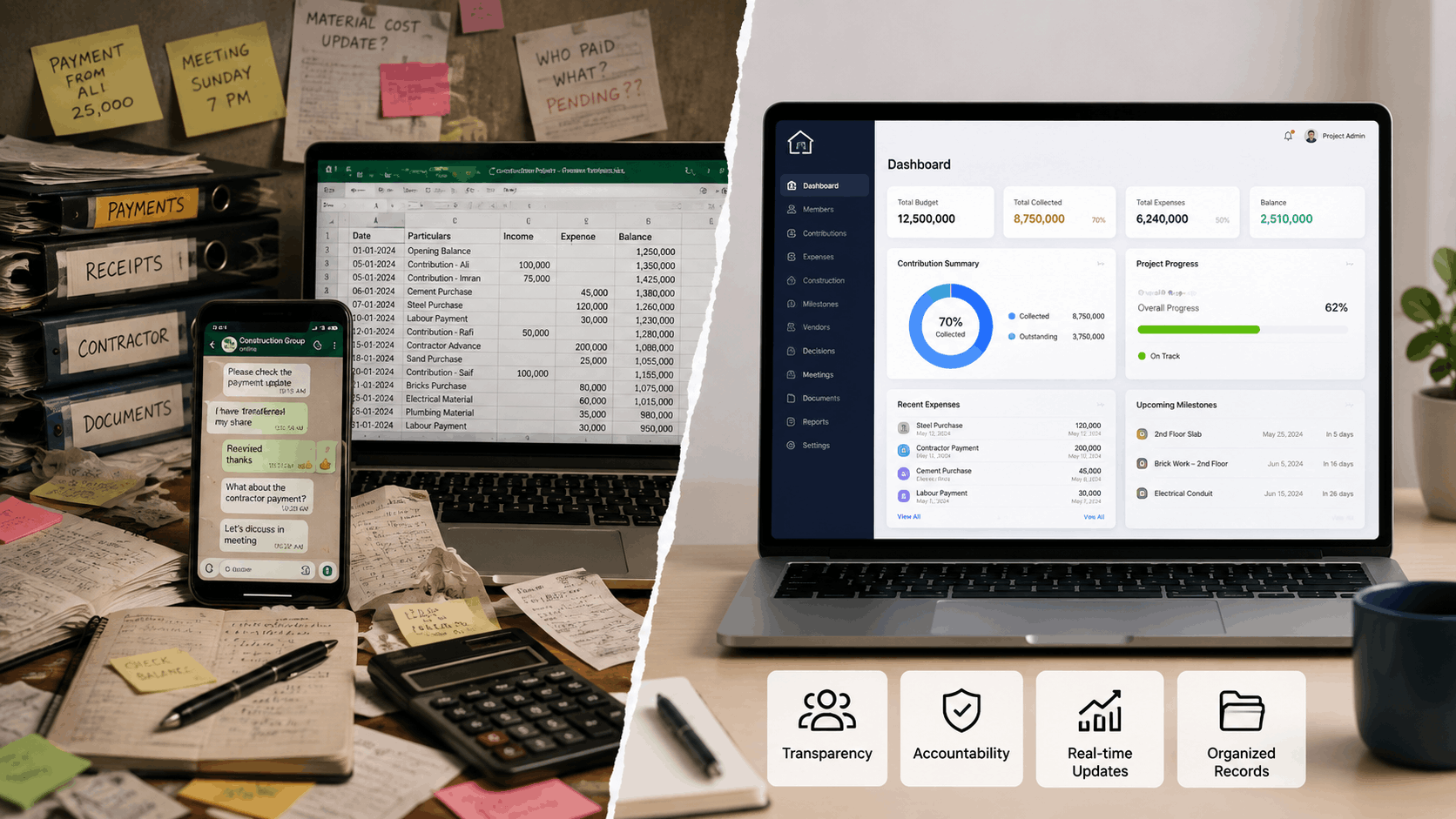
WhatsApp and spreadsheets are probably two of the most common tools used to manage a co-owned construction project.
And there is a good reason for that.
They are familiar, inexpensive, and easy to start with.
A group creates a WhatsApp chat. Someone creates an Excel or Google Sheets file. Members send payment confirmations through messages. Construction updates are posted in the group. Expenses are entered into a spreadsheet.
For a small project, this may seem perfectly manageable.
But construction projects rarely stay small.
As the project progresses, there are more payments, more expenses, more contractors, more documents, more decisions, and more people asking for updates.
Eventually, the combination of WhatsApp and spreadsheets starts creating problems of its own.
The Problem Isn't WhatsApp or Excel
WhatsApp and spreadsheets are useful tools.
The problem is using them as the system of record for an entire co-owned construction project.
They were not designed to manage the relationship between:
- Multiple co-owners
- Ownership percentages
- Individual financial obligations
- Construction milestones
- Contractor work
- Project budgets
- Formal decisions
- Voting
- Meetings
- Audit history
- Documents and project records
When all of these activities are managed through separate tools, information becomes fragmented.
And fragmented information creates management problems.
1. Important Information Gets Buried in WhatsApp
Imagine a project with 20 co-owners.
Over several months, the WhatsApp group contains thousands of messages.
Some messages are about construction progress.
Others are about payments.
Some contain receipts or screenshots.
Others contain decisions about materials, contractors, or budgets.
Someone asks:
"When did we approve this expense?"
The answer might be somewhere in a conversation from three months ago.
Finding it can take significant time.
Even worse, not everyone may have seen the original message.
WhatsApp is designed primarily for communication, not for maintaining a structured project record.
Important information can easily disappear inside an endless stream of conversations.
2. A Spreadsheet Usually Has One Person in Control
Spreadsheets are excellent for calculations.
But they also introduce a fundamental problem in a multi-owner project: who controls the data?
Suppose one person maintains the master spreadsheet.
They can potentially:
- Change an amount
- Modify a payment record
- Delete a row
- Change a date
- Update a formula
- Replace an old value
Sometimes these changes are completely legitimate.
Maybe there was a genuine correction.
But the other co-owners may have no easy way to determine:
- What changed?
- Who changed it?
- When was it changed?
- What was the previous value?
- Why was it changed?
This becomes particularly important when the spreadsheet contains financial information belonging to multiple people.
3. Financial Calculations Become Manual
Co-owned projects often require more than simple addition.
Each member may have a different ownership percentage.
Some may have an ownership multiplier.
Some may have paid in advance.
Others may have outstanding dues.
A member who overpaid may have a credit balance that should be applied to a future contribution.
Now imagine preparing the next funding request.
Someone has to calculate each member's obligation.
Then the calculations have to be checked.
Then the amounts need to be communicated to everyone.
Then payments need to be tracked.
Then the spreadsheet needs to be updated again.
This creates a significant amount of repetitive administrative work.
More importantly, every manual calculation creates an opportunity for an error.
4. Payment Status Is Difficult to Keep Current
A typical WhatsApp conversation might look like this:
"I transferred my contribution."
Then someone checks the bank account.
The finance manager updates the spreadsheet.
Another member asks whether their payment has been received.
Someone else asks how much remains outstanding.
This process can work temporarily.
But with dozens of members and repeated deposit schedules, it becomes difficult to maintain an accurate real-time picture.
The project needs to answer simple questions immediately:
- How much was requested?
- How much has been collected?
- Who has paid?
- Who is partially paid?
- Who is overdue?
- How much is still outstanding?
If those answers require manually checking several sources, financial management becomes unnecessarily difficult.
5. Construction Progress Becomes Dependent on Verbal Updates
A WhatsApp group might contain messages such as:
"The foundation work is almost complete."
Or:
"The contractor will start the next floor next week."
These messages provide information, but they don't create a structured construction timeline.
A co-owner should ideally be able to see:
- Current project phase
- Start and end dates
- Progress percentage
- Delayed milestones
- Assigned responsibilities
- Dependencies
- Budget for each phase
- Actual spending
- Expected completion
Without this structure, co-owners are often dependent on whoever happens to provide the latest update.
6. Contractor Information Gets Scattered
Contractor management creates another layer of complexity.
A contractor may have:
- A contract
- A defined scope
- Several deliverables
- Multiple milestones
- Invoices
- Payment requests
- Progress updates
- Approvals
If these are stored across email, WhatsApp, paper documents and spreadsheets, understanding the complete contractor history becomes difficult.
For example:
"Why did we pay this contractor $20,000?"
The answer shouldn't require searching through multiple conversations and files.
The project should be able to connect the payment to the relevant work package, milestone, approval and supporting documents.
7. Decisions Made in WhatsApp Are Difficult to Audit
Not every project decision needs a formal vote.
But important decisions should have a reliable record.
Consider a conversation about changing a contractor.
Several members express their opinions in WhatsApp.
Some agree.
Some disagree.
Someone eventually writes:
"Okay, let's go with the new contractor."
Was that an official decision?
Did everyone agree?
Was there a quorum?
Who was authorized to approve it?
What exactly was approved?
Months later, different people may remember the conversation differently.
A formal decision process provides a much clearer record.
8. Meeting Minutes Can Easily Be Lost
Many co-build groups hold meetings but don't maintain properly structured minutes.
Sometimes someone writes notes in a notebook.
Sometimes the minutes are typed into a document.
Sometimes the summary is simply posted in WhatsApp.
This creates another problem.
Meeting minutes should answer:
- When was the meeting held?
- Who attended?
- What was discussed?
- What decisions were made?
- What actions were assigned?
- Who is responsible?
- What is the deadline?
A project involving significant financial investment deserves more than a few messages saying, "Meeting went well."
9. Documents Become Difficult to Find
Construction generates a large amount of documentation.
There may be:
- Contracts
- Invoices
- Receipts
- Building plans
- Permits
- Bank statements
- Payment documents
- Meeting minutes
- Project photographs
- Vendor documents
If documents are shared through WhatsApp, they become difficult to organize.
If they are stored in different personal Google Drive folders or computers, access becomes inconsistent.
Someone eventually asks:
"Does anyone have the latest version of the contractor agreement?"
And the group starts searching.
A centralized project workspace can make this much easier.
10. There Is No Reliable Audit Trail
This may be the most serious issue.
Suppose an expense originally recorded as $5,000 later appears as $7,000.
What happened?
Was it a correction?
Was an additional payment made?
Was the original amount entered incorrectly?
Was the spreadsheet edited?
Without an audit trail, the group may not be able to determine what happened.
A trustworthy financial system should preserve the history of important changes.
For example:
Original amount: $5,000
Updated amount: $7,000
Changed by: Authorized user
Changed at: Specific timestamp
Reason: Documented correction
That history creates accountability.
11. The Finance Manager Becomes the "Human Database"
One of the biggest hidden problems with WhatsApp and spreadsheets is that knowledge often becomes concentrated in one person.
That person may know:
- Where the latest spreadsheet is
- Which members have paid
- Who owes money
- Which contractor was selected
- Where the contract is stored
- What was decided in the last meeting
- Which expenses are still pending
If that person becomes unavailable, the project can suddenly lose access to critical operational knowledge.
A properly structured system reduces this dependency.
Information should belong to the project, not to one individual.
12. Transparency Becomes Difficult as the Project Grows
The larger the project becomes, the more difficult it is to keep everyone informed through informal tools.
A co-owner shouldn't have to ask someone:
"Can you send me the latest financial report?"
Or:
"What is the current project status?"
Or:
"How much have I paid so far?"
Or:
"What decisions were made this month?"
The information should already be available to authorized members.
That is what transparency really means.
It doesn't mean giving everyone unrestricted access to everything.
It means giving each person appropriate, reliable visibility into the information they are entitled to see.
What Should Replace WhatsApp and Spreadsheets?
The answer isn't necessarily to stop using them completely.
WhatsApp can still be useful for casual communication.
Spreadsheets can still be useful for analysis and temporary calculations.
But neither should be the primary source of truth for a complex co-owned construction project.
A dedicated system can bring the important parts together:
Financial Management
Track deposits, expenses, vendor payments, labour costs, petty cash and bank accounts in one place.
Share-Based Contributions
Automatically calculate each co-owner's contribution based on ownership percentage, multiplier, previous payments and credit balance.
Deposit Schedules
Create structured funding requests and track each member's payment status.
Construction Progress
Manage milestones, timelines, progress percentages, budgets and actual costs.
Contractor Management
Connect vendor work packages, milestones, approvals and payments.
Governance
Manage decisions, discussions, votes, committees, meetings and action items.
Documentation
Keep project documents, receipts and site photographs organized within the project.
Auditability
Maintain a permanent history of important changes so the project has a trustworthy record of what happened.
The Goal Isn't More Software
The goal is not to add another application that everyone has to learn.
The goal is to reduce the number of places where important project information lives.
Instead of:
WhatsApp + Excel + Email + Google Drive + Paper Documents + Personal Notes
the project should move toward:
One shared project workspace.
That changes the role of technology.
Instead of spending time searching for information, calculating contributions, reconciling spreadsheets and asking for updates, the group can spend more time actually managing the project.
When Should a Co-Build Group Move Beyond Spreadsheets?
There is no specific number of co-owners that makes spreadsheets suddenly unusable.
The warning signs are more practical.
You may need a dedicated system when:
- Multiple people are maintaining financial records
- Contribution calculations are becoming complicated
- Members frequently ask for payment status
- Construction has multiple phases and contractors
- Important decisions are being made through chat
- Documents are scattered across different locations
- Financial changes need to be traceable
- The project manager is becoming a single point of dependency
- Co-owners are starting to question the accuracy of project information
At that point, the problem is no longer the spreadsheet itself.
The problem is that the project has outgrown the way it is being managed.
Conclusion
WhatsApp and spreadsheets are excellent starting points.
They are familiar, accessible and inexpensive.
But a co-owned construction project eventually becomes more complex than these tools were designed to handle.
When financial records, ownership calculations, construction progress, contractor payments, decisions, meetings and documents are scattered across different places, transparency becomes harder and administrative work increases.
A co-build project needs a system where information is structured, connected and traceable.
Because when multiple people own the same property, everyone deserves to know what is happening with their investment.
That is the problem Co Build Manager is designed to solve.
Share this article
Found this helpful? Share it with your team or co-owners.