When several people invest money into the same construction project, financial transparency becomes essential.
Everyone wants to know:
- How much money has been collected?
- How much has been spent?
- Who has paid?
- Which contractor received the money?
- What is the current project balance?
- Are we still within budget?
But there is another question that is just as important:
How do we know the numbers we see today are accurate?
That question is where an audit trail becomes important.
An audit trail doesn't just show the current state of a financial record. It preserves the history of important changes so the project can understand what happened over time.
For a co-owned construction project, that history can be the difference between having data and being able to trust the data.
What Is an Audit Trail?
An audit trail is a chronological record of changes made to information in a system.
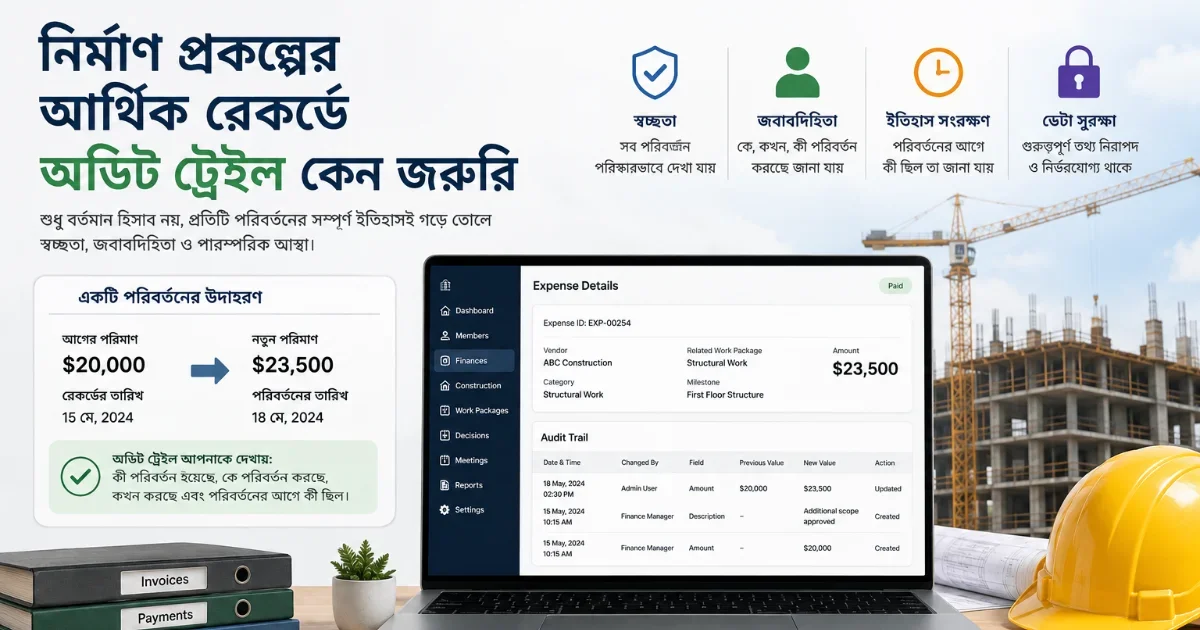
For example, imagine a project expense originally recorded as:
Amount: $20,000
Later, it becomes:
Amount: $23,500
A basic spreadsheet may simply show the latest value.
An audit trail can show:
| Information | Record |
|---|---|
| Previous amount | $20,000 |
| New amount | $23,500 |
| Changed by | Authorized user |
| Date & time | Recorded timestamp |
| Reason/context | Preserved with the change |
Now the project knows not only what the number is, but also how it got there.
That is the core value of an audit trail.
Why the Current Number Isn't Always Enough
Suppose a co-owner opens the financial dashboard and sees:
Contractor payment: $35,000
They might reasonably ask:
"Was it always $35,000?"
Maybe.
Or perhaps it was originally $30,000 and later increased.
Maybe an additional scope was approved.
Maybe the original amount was entered incorrectly.
Maybe a partial payment was updated.
Without historical information, several explanations are possible.
An audit trail makes the history visible.
Instead of asking people to remember what happened, the project can refer to a permanent record.
Spreadsheets Have a Fundamental Limitation
Spreadsheets are useful for financial calculations.
But when a spreadsheet is used as the primary financial record for a multi-owner construction project, one major problem appears:
The data can change without creating a reliable history.
Someone can edit a cell.
Someone can replace a value.
Someone can delete a row.
Someone can change a formula.
Someone can copy data into another version of the spreadsheet.
Even if every person involved is acting honestly, these changes can create uncertainty.
And when money belonging to multiple co-owners is involved, uncertainty quickly becomes a trust problem.
Accidental Changes Can Be Just as Serious
An audit trail isn't only about preventing intentional manipulation.
People make mistakes.
A finance manager might accidentally enter:
$50,000
instead of:
$5,000
Someone may update the wrong payment.
A vendor amount may be corrected after an invoice is revised.
A payment status may be changed accidentally.
These are normal human errors.
The problem occurs when there is no reliable history showing what happened.
Without an audit trail, an accidental change can look exactly like an intentional one.
"Who Changed This?"
This is one of the most useful questions an audit trail can answer.
Suppose a co-owner notices that a payment amount looks different from what they remember.
Instead of starting an argument, the project can check the record.
The audit history can identify:
- Which record changed
- What the previous value was
- What the new value is
- Which user made the change
- When the change happened
This moves the conversation away from:
"Who changed the spreadsheet?"
and toward:
"Here is exactly what changed and when."
That is a much healthier way to manage a shared project.
"What Was It Before?"
Knowing the previous value is particularly important.
Consider a deposit record.
Yesterday:
Deposit: $15,000
Today:
Deposit: $12,000
The current system shows $12,000.
But without the previous state, the project doesn't know whether:
- The original entry was incorrect
- A payment was partially reversed
- A correction was made
- Someone changed the amount incorrectly
An audit trail preserves the previous state.
That creates historical context.
Financial Records Have a Story
A financial record isn't just a number.
It represents an event in the project's history.
For example:
Deposit created
→ Payment recorded
→ Payment reconciled
→ Status updated
→ Supporting document attached
→ Correction made
→ Final status confirmed
Each step can tell part of the story.
When those changes are preserved, the project has a complete history instead of only the final result.
Audit Trails Become More Important as Projects Grow
A small project with two co-owners may be able to resolve many questions through conversation.
A project with 30 or 50 co-owners is different.
There may be:
- Hundreds of deposits
- Thousands of expenses
- Multiple bank accounts
- Several contractors
- Many construction milestones
- Recurring funding schedules
- Numerous approvals
- Frequent financial updates
No individual can reasonably remember every change.
As the amount of data increases, the project becomes increasingly dependent on its records.
And the more the project depends on its records, the more important the integrity of those records becomes.
An Audit Trail Protects Everyone
It is easy to think of an audit trail as something that protects co-owners from a finance manager.
But it protects everyone.
Co-owners
They can verify how financial information changed.
Finance managers
They can demonstrate that a disputed change was legitimate.
Project administrators
They can investigate errors.
Committees
They can review decisions and financial activity.
Contractors and vendors
Relevant payment records can be traced back to the underlying project activity.
An audit trail doesn't assume someone is dishonest.
It creates a system where nobody has to rely entirely on trust or memory.
Transparency Doesn't Mean Everyone Can Edit Everything
There is an important distinction between visibility and permission.
Co-owners may need to see financial information.
That doesn't mean every co-owner should be allowed to modify financial records.
A well-designed system can control who is allowed to:
- View
- Create
- Edit
- Approve
- Delete
different types of information.
This is where role-based access control becomes important.
For example, a read-only co-owner may be able to see project financial information without being able to modify it.
A finance manager may be allowed to record transactions.
An authorized approver may be required before certain changes become effective.
The audit trail then records the actions that authorized users actually take.
Not Every Field Needs the Same Protection
Different information has different levels of sensitivity.
Changing a project description may not have the same impact as changing:
- Deposit amount
- Payment status
- Ownership percentage
- Contractor payment
- Budget
- Milestone cost
This is why CoBuild Manager includes Data Protection Profiles and Field Protection Rules.
Projects can define which data fields should receive stronger protection and when those fields become locked for normal editing.
A grace period can allow legitimate corrections before protection takes effect, while role-based override capabilities can handle exceptional cases.
This creates a balance between flexibility and data integrity.
What Is an Immutable Audit Log?
An immutable audit log is designed so that historical records aren't simply overwritten or casually edited.
Instead of updating the history itself, new events are added to the record.
Think of it as a timeline.
For example:
10:02 AM — Expense created: $20,000
11:15 AM — Expense description updated
2:30 PM — Amount changed to $22,000
3:00 PM — Change approved
The history remains available.
The latest state tells you where the record stands now.
The audit history tells you how it got there.
These are two different but equally important views.
Audit History Helps Resolve Disputes
Disagreements are almost inevitable in group projects.
The goal isn't to eliminate every disagreement.
The goal is to make disagreements easier to resolve.
Imagine two co-owners disagree about a payment.
One says:
"The contractor was originally approved for $40,000."
Another says:
"No, it was $45,000."
Without a historical record, the discussion may turn into a memory contest.
With an audit trail, the project can inspect the relevant history.
Perhaps the original amount was $40,000.
Later, an approved change request increased it to $45,000.
Now the explanation is straightforward.
The audit trail doesn't decide who is right.
It provides the evidence needed to understand what happened.
Audit Trails Are Valuable Beyond Finance
Although financial records are particularly sensitive, the same principle applies across the project.
Consider a construction milestone.
Originally:
Progress: 40%
Later:
Progress: 65%
The project may want to know:
- Who reported the progress?
- When?
- What was the previous progress?
- Was the update associated with a site report?
Similarly, a project decision may have:
- Created date
- Voting period
- Member participation
- Final outcome
A governance system becomes much stronger when the history of these activities is preserved.
The Difference Between an Audit Log and a Request Log
These two types of records serve different purposes.
An audit log records changes to project data.
A request log records API activity and system access.
For example, an audit log might show:
Expense amount changed from $20,000 to $22,000.
A request log can provide information about the system request associated with an action, helping with security and forensic investigation.
Together, they provide a deeper picture of both what changed and how the system was accessed.
A Reliable Audit Record Should Answer Four Questions
At a minimum, a useful audit history should answer:
What changed?
Identify the record and the field affected.
Who changed it?
Identify the user responsible for the action.
When did it change?
Record the date and time.
What was it before?
Preserve the previous state alongside the new state.
These four questions form the foundation of meaningful accountability.
What Good Auditability Looks Like
Imagine a co-owner reviewing a contractor payment.
They should be able to understand:
Payment: $50,000
Vendor: ABC Construction
Work package: Structural Work
Milestone: First Floor Structure
Status: Approved
And if the amount was changed:
Previous: $45,000
New: $50,000
Changed by: Authorized user
Timestamp: Recorded
Related change: Approved scope adjustment
Now the payment has context.
It isn't just a number in a database.
It is a traceable project event.
Auditability Should Not Create More Work
A common concern is that maintaining detailed histories will create additional administrative work.
A well-designed system should do the opposite.
The audit trail should be generated automatically when users interact with the system.
Users shouldn't have to maintain a second spreadsheet explaining what they changed.
The system records the event as part of normal operation.
This is one of the key advantages of having auditability built into the platform rather than trying to reconstruct history manually later.
How CoBuild Manager Protects Project History
CoBuild Manager uses an immutable, append-only audit log for system activity.
The audit record preserves information such as:
- What operation occurred
- The affected data
- Previous state
- New state
- User responsible
- IP address
- Timestamp
This creates a permanent history of create, update, and delete operations.
The project therefore has a reliable record of what happened rather than depending on the current database state alone.
CoBuild Manager also provides request logs for API activity, data protection profiles for sensitive project data, field-level protection rules, and formal change requests for structural project changes.
Together, these features create multiple layers of accountability.
The Goal Is Confidence, Not Suspicion
The purpose of an audit trail isn't to make co-owners suspicious of one another.
It is actually the opposite.
When everyone knows that important records are traceable, people don't need to constantly question whether information is accurate.
The system provides confidence.
A finance manager doesn't have to defend every correction personally.
A co-owner doesn't have to assume that a number was changed improperly.
A committee doesn't have to reconstruct a decision from old messages.
The record speaks for itself.
From "Trust Me" to "You Can Verify It"
There is a meaningful difference between these two statements:
"The spreadsheet is correct. Trust me."
and:
"Here is the current record, and here is its complete change history."
The second approach is stronger.
It doesn't depend on who manages the project.
It doesn't depend on who remembers what happened.
It doesn't depend on whether everyone gets along.
It creates a system where important information can be independently verified.
That is what transparency should look like in a co-owned construction project.
Conclusion
A co-owned construction project involves other people's money, shared decisions, and long-term commitments.
In that environment, the current state of the data is only part of the story.
Co-owners also need to know how the data got there.
An audit trail provides that history.
It records what changed, who changed it, when it changed, and what existed before the change. It helps distinguish legitimate corrections from unexplained changes, makes disputes easier to resolve, and gives everyone greater confidence in the project's records.
The goal isn't to assume that someone will make a mistake—or that someone might act improperly.
The goal is to build a system where trust doesn't depend on assumptions.
Because when multiple people own the same project, the strongest financial record isn't simply one that shows the numbers.
It's one that can prove their history.
Share this article
Found this helpful? Share it with your team or co-owners.

Tariqul Islam
Real Estate Expert
Tariqul Islam brings over 20 years of hands-on expertise in the Bangladeshi construction and real estate sectors. Having spearheaded numerous large-scale commercial and residential projects across Dhaka and major divisions, he specializes in lean project management, supply chain optimization, and sustainable building practices. At CoBuild Manager, Tariqul shares his deep industry insights to help developers and contractors streamline their workflows and build smarter.