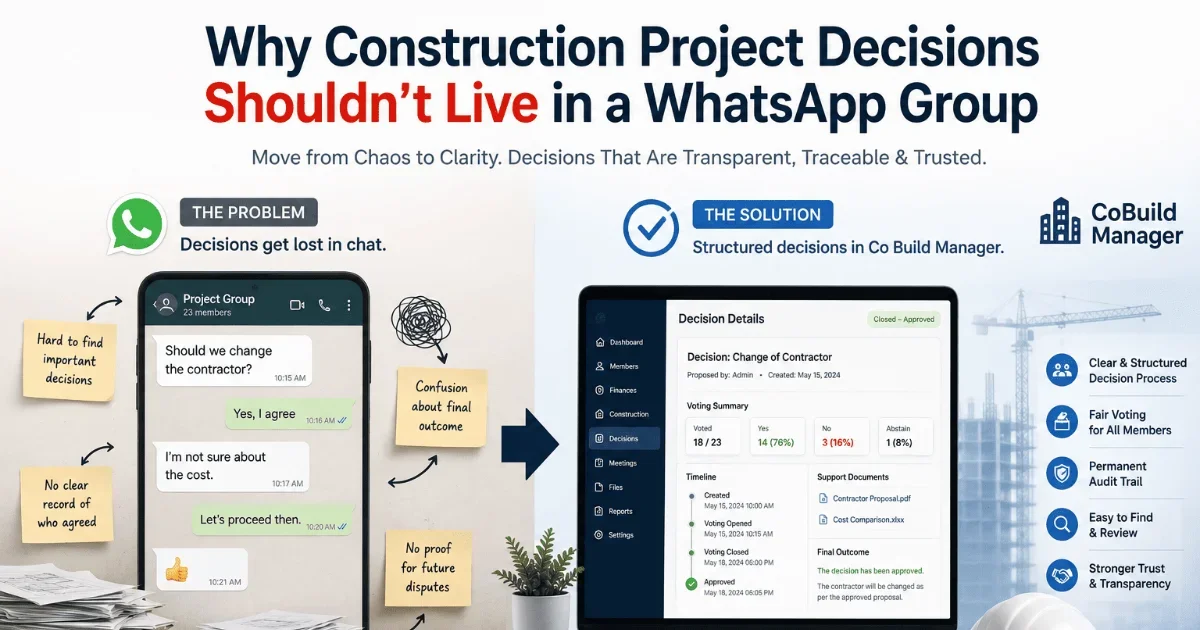
A co-owned construction project involves decisions almost every day.
Which contractor should be hired? Should an unexpected expense be approved? Should the budget increase? Can the project scope be changed? Should a contractor’s proposed variation be accepted?
For a group of co-owners, these aren’t just conversations. Many decisions involve significant money, affect construction progress, and ultimately impact every shareholder.
Yet many co-build groups manage these decisions through a WhatsApp group.
Someone asks a question.
A few people respond.
Someone says, “I agree.”
Another person disagrees.
Eventually, someone writes:
“Okay, let’s proceed.”
And the conversation moves on.
At the time, it feels efficient.
Months later, it can become a problem.
The Real Problem With Making Decisions in Chat
WhatsApp is built for fast communication.
A construction project needs something more: structured, traceable decision-making.
The problem isn’t that WhatsApp is bad. The problem is that important decisions can disappear inside hundreds or thousands of messages.
A typical project group might contain:
- Construction updates
- Payment confirmations
- Photos
- Contractor messages
- Questions
- Meeting reminders
- Documents
- Opinions
- Casual conversations
- Formal decisions
When everything lives in the same stream, it becomes difficult to tell the difference between a casual comment and an actual decision.
And that distinction matters.
“Who Actually Approved This?”
Imagine a contractor proposes an additional $30,000 of work.
The proposal is posted in the group.
Three co-owners say yes. Two say no. Several don’t respond.
The project manager later proceeds with the work.
A few months later, another co-owner asks:
“Who approved the additional $30,000?”
Now the project has a problem.
Was it actually approved?
Was the required number of votes reached?
Was the decision within the group’s authority?
Did the people who didn’t respond count as abstentions—or agreement?
Was the final decision ever formally recorded?
The chat history may contain pieces of the conversation, but it doesn’t necessarily provide an authoritative decision record.
Silence Shouldn’t Be Confused With Agreement
This is one of the biggest weaknesses of informal group communication: ambiguity.
Suppose someone posts:
“Everyone okay with changing the contractor?”
Ten people are involved.
Five say yes.
Two say no.
Three don’t respond.
What happened?
Did the group approve the change?
Are the three non-responders abstaining?
Was a quorum required?
Does the decision depend on the number of members or their ownership shares?
These questions cannot reliably be answered by counting messages, reactions, or emojis.
A formal decision process needs defined rules.
Not Every Co-Owner Has the Same Ownership Share
Co-owned projects often have different ownership percentages.
One member may own 25%.
Another may own 10%.
Another may own 5%.
That creates an important governance question:
Should every co-owner have one vote, or should voting reflect ownership?
Different projects may legitimately choose different approaches. What matters is that the method is clear before an important decision is made.
Co Build Manager supports both per-member voting and per-share voting, allowing a project’s governance structure to determine how a decision is weighted.
That is very different from counting reactions in a chat group.
Decisions Need a Clear Beginning and End
A proper decision should have a defined lifecycle:
Decision Created → Discussion → Voting Opened → Members Participate → Voting Closed → Outcome Recorded
This answers basic questions that chat often leaves unclear:
- When did the decision start?
- What exactly was being decided?
- When did voting open?
- Who was allowed to participate?
- When did voting close?
- What was the final outcome?
Co Build Manager maintains a decision timeline showing when a decision was created, when voting opened and closed, how members voted, and the final outcome.
The result is not just a conversation. It is a project record.
Discussion and Decisions Are Not the Same Thing
This distinction is important.
A group should be able to discuss an issue without every message becoming a formal vote.
For example:
“The current contractor is taking longer than expected. Should we consider alternatives?”
That’s a discussion.
Members can ask questions, share information, review options, and express opinions.
Once the group is ready to make a formal decision, the issue can move into a voting process.
A useful structure is:
Discussion → Deliberation → Decision
Co Build Manager supports polls, structured discussions, and formal votes as different types of decision activity, so informal discussion and formal approval don’t have to be mixed together.
A Decision Should Answer “What, Who, When, and Why”
Consider a decision made today.
Six months later, someone asks:
“Why did we choose this contractor?”
The answer shouldn’t depend on someone remembering what happened—or searching through thousands of messages.
A useful decision record should show:
- What was being decided
- What options were considered
- Who participated
- How members voted
- When the vote took place
- What the final outcome was
- Relevant documents or discussion
That creates something every long-running project needs:
institutional memory.
The decision belongs to the project—not to the person who happened to manage the WhatsApp group.
Financial Decisions Need More Structure
Some decisions are especially important because they directly affect project finances.
For example:
- Approving an unexpected expense
- Increasing the construction budget
- Changing a contractor
- Approving additional scope
- Authorizing a major purchase
- Changing a project specification
These shouldn’t be treated like ordinary chat messages.
They should have a clear trail:
Proposal → Review → Approval → Action
This becomes even more important when a decision changes the project’s financial data, scope, or contractual commitments.
What Happens When Someone Can’t Participate?
Co-owners don’t always live in the same place.
Someone may be traveling. Someone may be busy with work. Someone may simply be unavailable when an important decision is being discussed.
If participation matters, the project needs a structured way to handle that situation.
Co Build Manager supports vote delegation, allowing a co-owner to formally delegate their vote on a specific decision to another member.
That is much stronger than:
“I’m not available. Just vote for me.”
A formal delegation creates a record of who delegated, to whom, and for which decision.
Committees Can Make Governance More Practical
Not every decision needs to involve every co-owner.
Larger projects may have committees responsible for specific areas, such as:
- Finance
- Building
- Procurement
- Maintenance
A committee can have defined members and decision responsibilities.
This makes governance more practical as the project grows without sacrificing transparency.
Co Build Manager supports formally defined committees, including membership, meeting records, and decision tiers.
The result is a governance structure that can scale with the project.
Meetings Should Produce More Than Conversation
The same problem exists with meetings.
A group can spend two hours discussing important issues. Everyone leaves feeling that they understand what happened.
Three months later, someone asks:
“What exactly did we agree on?”
Without proper minutes, the answer may depend on memory.
A useful meeting record should capture:
- Meeting date
- Agenda
- Attendees
- Decisions
- Discussion points
- Action items
- Responsible members
- Attachments
- Follow-ups
Co Build Manager provides structured meeting records with agendas, attendance tracking, minutes, action items, attachments, and versioned minute history.
A meeting then becomes more than a conversation. It becomes part of the project’s permanent record.
Important Announcements Shouldn’t Get Lost in Chat
Not every important message is a decision.
Sometimes everyone simply needs to know something:
“The site will be closed for two weeks.”
“The building inspection is scheduled for Monday.”
“The next deposit deadline is September 15.”
“The contractor will begin structural work next week.”
These messages can easily disappear inside a busy chat group.
A formal notice board gives important announcements a dedicated, searchable place where members can find them later.
Co Build Manager separates formal notices from ordinary messaging, providing a permanent and categorized announcement channel for project members.
Keep Project Communication With the Project
There is another problem with relying too heavily on personal messaging applications.
Important project communication can become scattered across:
- WhatsApp groups
- Personal messages
- Phone calls
- Meetings
- Individual documents
Later, reconstructing the history of a project issue becomes difficult.
A project-specific communication workspace keeps discussions, messages, decisions, notices, and related information connected to the project.
Co Build Manager provides project-scoped messaging and threaded discussions so communication remains searchable and organized within the project workspace.
Governance Is About More Than Voting
Good governance isn’t simply about counting votes.
It is about creating a predictable process for making decisions.
A healthy process should answer:
- Who can propose a decision?
- Who can participate?
- Who can vote?
- How is the vote weighted?
- What constitutes approval?
- When does voting close?
- What happens after approval?
- Where is the final decision recorded?
When these rules are defined in advance, disagreements become easier to resolve.
Without clear rules, every controversial decision can turn into a debate about the process itself.
A Decision Should Lead to Action
Suppose the group approves a major change to the project.
The decision shouldn’t be the end of the process.
It may result in:
- A budget increase
- A scope change
- A contractor change
- A new purchase
- A revised milestone
- A new financial commitment
That leads to an important principle:
A decision should be connected to the action it authorizes.
Co Build Manager uses a formal Change Request workflow for structural project changes such as budget increases, scope amendments, and vendor contract changes.
The chain becomes:
Decision → Approval → Change Request → Project Change
Rather than:
WhatsApp Message → Someone Changes the Spreadsheet
That connection makes it much easier to understand not only what was approved, but also what happened because of the approval.
Protecting the Decision History
For important projects, the history of a decision matters.
Imagine the original outcome was:
Option A approved.
Later, the record somehow says:
Option B approved.
Which one is correct?
For decisions involving significant financial or ownership consequences, the project needs a reliable history.
Co Build Manager maintains a permanent decision timeline, including voting activity and the final outcome. Its broader audit system also records changes to system data with the previous state, new state, user, IP address, and timestamp.
The goal is simple:
The project should be able to trust its records.
WhatsApp Still Has a Place
None of this means WhatsApp is useless.
It can be excellent for:
- Quick reminders
- Informal conversations
- Casual updates
- Emergency communication
The problem starts when WhatsApp becomes the official record of the project.
A useful distinction is:
Chat for conversation.
Project system for decisions, records, approvals, and accountability.
That separation can dramatically reduce confusion.
A Better Decision-Making Flow
For an important co-owned construction decision, the process can be simple:
1. Define the Issue
Clearly explain what needs to be decided.
2. Provide the Context
Attach relevant documents, estimates, proposals, financial information, or other supporting material.
3. Allow Discussion
Give members time to ask questions and consider the alternatives.
4. Open the Decision
Define the options, voting method, and approval rules.
5. Collect Votes
Record who participated and how they voted.
6. Close the Decision
Apply the project’s predefined approval rules.
7. Record the Outcome
Preserve the final decision and its timeline.
8. Execute the Decision
Create the relevant change request, purchase, budget update, contractor action, or other project activity.
This creates a clear connection:
Discussion → Decision → Approval → Action → Record
The Goal Isn’t Bureaucracy
Formal governance can sound complicated.
But good governance isn’t about creating paperwork for every small decision.
A quick conversation about the color of a presentation slide doesn’t need a formal vote.
A decision to spend $100,000 on a new contractor is different.
The greater the financial, construction, or ownership impact, the more important a clear decision record becomes.
Good governance should make important decisions easier to understand—not harder to make.
How Co Build Manager Brings It Together
Co Build Manager is designed around this principle.
Its governance tools bring together:
- Decisions
- Polls
- Structured discussions
- Formal votes
- Committees
- Vote delegation
- Meetings
- Meeting minutes
- Action items
- Notices
- Project messaging
- Notifications
- Change requests
These aren’t just separate communication features.
Together, they create a governance layer for the co-owned construction project.
Members can still communicate informally when appropriate. But when something important needs to be decided, approved, recorded, and acted on, it has a formal place in the project.
Conclusion: Your Project Deserves More Than a Chat History
A co-owned construction project is a shared financial and physical investment.
Important decisions deserve more than a message buried in a busy chat group.
WhatsApp can help people communicate.
It shouldn’t be where the project’s most important decisions live.
A stronger approach is to separate:
Conversation → Discussion → Decision → Approval → Action → Record
When voting rules are clear, meetings are documented, decisions are preserved, and approved changes are connected to the work they authorize, co-owners don’t have to rely on memory—or search through thousands of messages—to understand what happened.
The goal isn’t to replace trust with bureaucracy.
It’s to support trust with transparency, clear processes, and reliable records.
Because when everyone owns the project, everyone deserves to know:
What was decided.
Why it was decided.
Who authorized it.
And what happened next.
Share this article
Found this helpful? Share it with your team or co-owners.

Tariqul Islam
Real Estate Expert
Tariqul Islam brings over 20 years of hands-on expertise in the Bangladeshi construction and real estate sectors. Having spearheaded numerous large-scale commercial and residential projects across Dhaka and major divisions, he specializes in lean project management, supply chain optimization, and sustainable building practices. At CoBuild Manager, Tariqul shares his deep industry insights to help developers and contractors streamline their workflows and build smarter.