
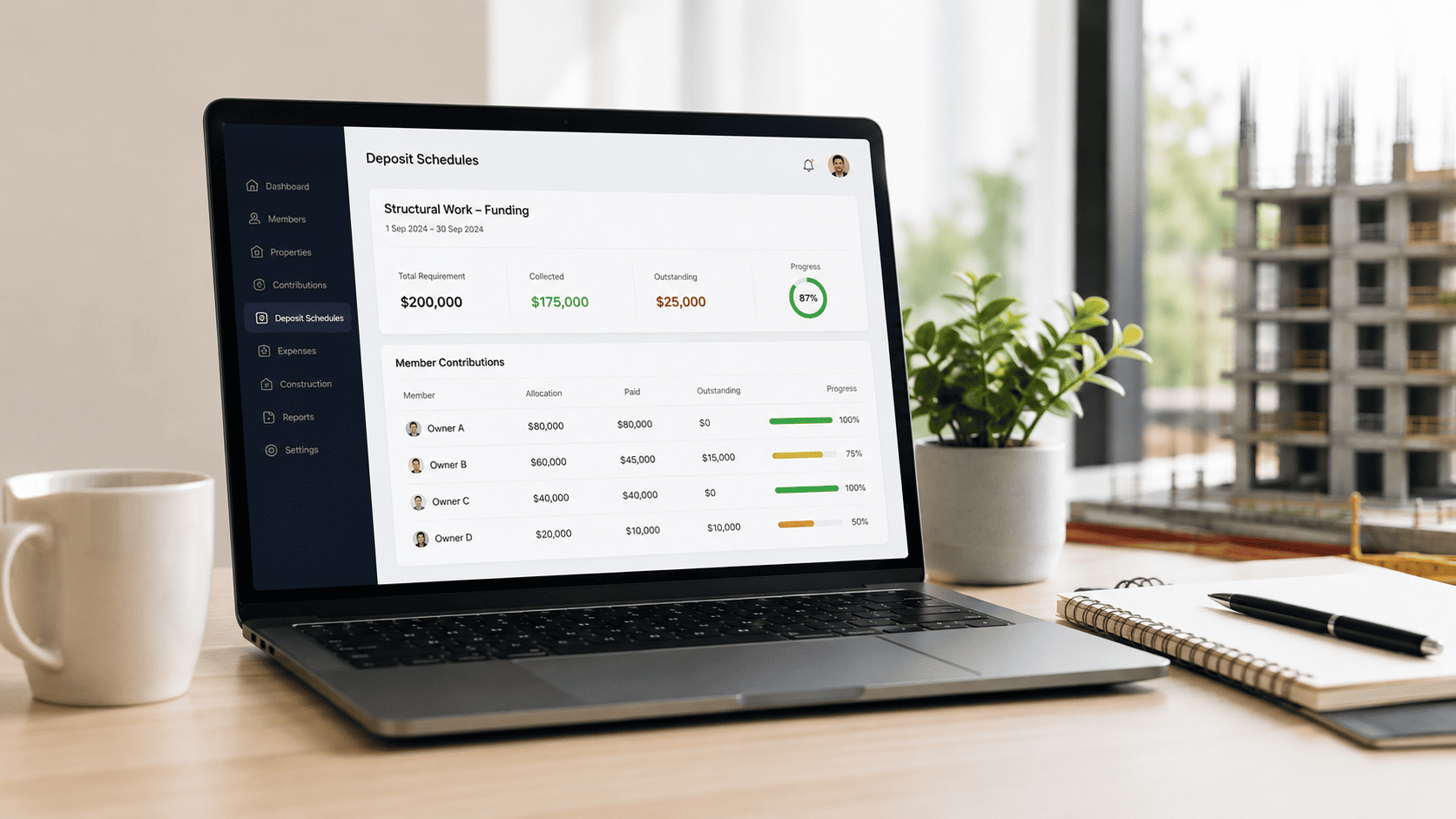
A construction project doesn't spend all of its money on the first day.
Funding is required throughout the project.
The foundation needs materials and labour. Structural work requires another round of funding. Later, electrical, plumbing, finishing and other phases require additional payments.
When several people jointly own the property, the project needs a reliable way to collect these funds from each co-owner.
This is where a deposit schedule becomes useful.
A deposit schedule is a structured call for funds that defines when money needs to be collected, how much is required, and how that amount is distributed among the project's co-owners.
Instead of sending an informal message saying:
"Everyone please deposit money for the next construction phase."
the project can create a formal funding schedule with clear amounts, dates and payment status.
What Is a Deposit Schedule?
A deposit schedule defines a specific funding requirement for a project.
It can include:
- A schedule name
- Description
- Start date
- End date
- Total funding requirement
- Deposit type
- Per-member allocation
- Payment progress
- Outstanding amounts
- Related construction milestone
For example:
Structural Work — Funding Schedule
Funding requirement: $200,000
Collection period: September 1–September 30
The total amount is then distributed among the co-owners according to the project's ownership rules.
Each member gets an individual allocation.
| Co-owner | Allocation | Paid | Outstanding |
|---|---|---|---|
| Owner A | $80,000 | $80,000 | $0 |
| Owner B | $60,000 | $45,000 | $15,000 |
| Owner C | $40,000 | $40,000 | $0 |
| Owner D | $20,000 | $10,000 | $10,000 |
| Total | $200,000 | $175,000 | $25,000 |
Now the project has a clear picture of its collection status.
Why Construction Projects Need Multiple Funding Calls
Construction spending happens in stages.
A project might move through phases such as:
- Site preparation
- Foundation
- Structural work
- Brickwork
- Electrical and plumbing
- Plastering
- Flooring
- Finishing
- External works
Each phase can have different funding requirements.
For example:
Foundation
Funding is required for excavation, reinforcement, concrete and labour.
Structural Work
Additional funding is required for columns, slabs, reinforcement and other structural materials.
Finishing
Later funding may be required for tiles, doors, fixtures, painting and other finishing work.
Instead of collecting the entire projected construction cost at once, the project can collect money according to its funding needs.
Deposit schedules provide the structure for doing this.
Deposit Schedule vs Informal Payment Request
There is an important difference between a structured deposit schedule and an informal payment request.
An informal request might look like:
"We need another $100,000. Please send your share by next Friday."
That's communication.
A deposit schedule is a financial record.
It can answer:
- Why is this money being collected?
- How much is required?
- When should it be paid?
- How much does each co-owner owe?
- How much has each person paid?
- Who is outstanding?
- How much has been collected in total?
The difference becomes increasingly important as the project grows.
How Individual Contributions Are Calculated
A deposit schedule shouldn't simply divide the total amount equally among all members.
Co-owners may have different ownership percentages and ownership multipliers.
Suppose a project needs to collect $100,000 and has four members:
| Member | Ownership |
|---|---|
| Owner A | 40% |
| Owner B | 30% |
| Owner C | 20% |
| Owner D | 10% |
The basic allocation would be:
- Owner A — $40,000
- Owner B — $30,000
- Owner C — $20,000
- Owner D — $10,000
The project's defined ownership rules determine how the final allocation is calculated.
The important thing is that the calculation should be consistent, transparent and traceable.
Previous Payments Also Matter
A member's allocation doesn't necessarily mean that they need to pay the entire amount again.
Suppose:
Current allocation: $30,000
Already paid: $20,000
The remaining amount is:
$10,000
The deposit schedule should therefore distinguish between:
Amount Allocated
and
Amount Outstanding
This makes the payment status much easier to understand.
What About Overpayments?
Sometimes a co-owner pays more than their current obligation.
For example:
Current allocation: $30,000
Payment: $35,000
The additional $5,000 should not simply disappear into the project's records.
It can become a credit balance for that member.
That credit can then be applied to future obligations.
This is particularly useful for long-running projects where members may make advance contributions.
A structured deposit system should therefore be able to account for:
Allocation → Payment → Outstanding / Credit
Tracking the Progress of a Deposit Schedule
Creating the schedule is only the beginning.
The project also needs to know how successfully the funding request is being collected.
For example:
Total scheduled: $200,000
Collected: $175,000
Outstanding: $25,000
The project can also track individual progress.
| Member | Allocation | Paid | Progress |
|---|---|---|---|
| Owner A | $80,000 | $80,000 | 100% |
| Owner B | $60,000 | $45,000 | 75% |
| Owner C | $40,000 | $40,000 | 100% |
| Owner D | $20,000 | $10,000 | 50% |
This gives the finance manager a live view of collection progress.
It also makes follow-up much easier.
Instead of asking everyone for an update, the project can identify exactly which members have outstanding balances.
Connecting Funding to Construction Milestones
One of the most useful concepts is connecting a deposit schedule to a construction milestone.
Suppose the project has a milestone called:
Second Floor Structural Work
The project may create a corresponding deposit schedule to fund that phase.
Now there is a direct relationship:
Construction Milestone → Funding Requirement → Deposit Schedule → Member Contributions
This provides context to the financial request.
Co-owners aren't simply being asked for money.
They can understand what project activity the funding is associated with.
Why This Connection Matters
Financial information becomes much more meaningful when it is connected to construction progress.
Consider two situations.
Situation A
"We collected $150,000 this month."
That's useful, but incomplete.
Situation B
"We collected $150,000 for the structural work milestone, which is currently 70% complete."
That's much more informative.
The second statement connects money to physical project progress.
This is one of the key benefits of integrating financial management with construction management.
Deposit Schedules Reduce Manual Work
Without structured schedules, the finance manager may need to maintain several separate records.
For each funding request, they may have to:
- Calculate each member's share.
- Send payment instructions.
- Record payments.
- Check bank statements.
- Update the spreadsheet.
- Calculate outstanding balances.
- Track advance payments.
- Send reminders.
- Prepare collection reports.
Then the same process starts again for the next funding request.
A structured deposit schedule can centralize much of this information.
The project has one record for the funding request and a clear allocation for every member.
Payments can then be recorded against those allocations.
Deposit Schedules Create Accountability
A structured schedule also creates accountability for both sides.
For the project
The project knows:
- How much funding was requested
- How much has been collected
- How much remains outstanding
- Which members are behind
- Which construction phase the funding supports
For the co-owner
The member knows:
- How much they are expected to contribute
- Why they are being asked to contribute
- How much they have already paid
- How much remains outstanding
- Whether they have a credit balance
This reduces ambiguity.
What Happens When a Member Doesn't Pay?
Construction schedules often depend on timely funding.
If several members don't contribute on time, the project may face a cash-flow problem.
A deposit schedule makes the situation visible.
For example:
Scheduled: $200,000
Collected: $150,000
Outstanding: $50,000
The finance manager can immediately identify the members responsible for the outstanding amount.
This is much more actionable than discovering the shortfall after trying to pay a contractor.
It also gives the group an opportunity to address the problem before it affects construction progress.
Deposit Schedules Should Have Defined Dates
A funding request should have a clear collection period.
For example:
Start: September 1
End: September 30
This provides a defined window for contributions.
It also allows the project to identify overdue payments more clearly.
Without defined dates, "please pay soon" can remain ambiguous.
With a defined schedule, the project can distinguish between:
- Not yet due
- Due
- Partially paid
- Fully paid
- Overdue
That creates a much clearer financial process.
Deposit Schedules Are Not Just About Money
Although the primary purpose is financial collection, deposit schedules also improve project communication.
A co-owner can understand:
What is being funded?
How much do I owe?
When is it due?
How much have I paid?
What remains?
What construction activity is this funding associated with?
That context is valuable.
It transforms a payment request from an isolated financial message into part of the project's overall plan.
How Co Build Manager Handles Deposit Schedules
Co Build Manager provides dedicated Deposit Schedule Management as part of its financial system.
A schedule can contain:
- Name
- Description
- Date range
- Deposit type
- Total funding requirement
- Per-member allocation
- Payment progress
- Outstanding amount
- Related project milestone
When a schedule is created, the system calculates and records the expected contribution for each co-owner based on the project's ownership configuration.
The system can then track:
Amount Due → Amount Paid → Outstanding → Progress %
Credit balances from previous overpayments can also be carried forward and used against future obligations.
This creates a continuous financial record rather than a series of disconnected payment requests.
From Funding Request to Construction Progress
The real value of a deposit schedule becomes clearer when it is connected to the rest of the project.
Consider this flow:
Milestone Created
↓
Funding Requirement Identified
↓
Deposit Schedule Created
↓
Individual Member Allocations Calculated
↓
Members Make Payments
↓
Collection Progress Tracked
↓
Construction Work Progresses
↓
Expenses Recorded Against the Project
This connects the project's financial and physical sides.
The group can see not only how much money has been collected, but also why it was collected and how it relates to the construction plan.
Conclusion
A construction project needs money at different stages.
For a co-owned project, collecting that money fairly and transparently requires more than sending payment requests through a messaging group.
A deposit schedule provides a structured way to manage each funding cycle.
It defines:
- How much the project needs
- When the money is needed
- How much each co-owner should contribute
- How much each person has paid
- What remains outstanding
- Whether anyone has a credit balance
- Which construction milestone the funding supports
Most importantly, it creates a clear connection between co-owner contributions and construction progress.
When funding requests are structured, payment status is visible, and individual obligations are calculated consistently, managing project finances becomes significantly easier.
A co-build project shouldn't have to ask, "Who has paid?"
It should already know.
Share this article
Found this helpful? Share it with your team or co-owners.